
#On the Account Now Surveyed
This survey was conducted in A.S. 201 and covers a single entry in the failure catalogue of the Order of Saint Ephrath. The entry is called the Cold Fire of Avignon. It describes a street execution that failed, a Prior who would not let it fail completely, and the promotion he received afterwards. The account does not record the year of the execution, and this office will not invent one. A.S. 201 is the date of this assessment. It is not the date of the rain.
The source is the Order's own catalogue of its failures. Brothers of the third vow recite it in a sealed chamber beneath Zaragoza, after standing for seven minutes in silence before a cracked glass pillar. The excerpt now in circulation gives the entry in full: Cold Fire of Avignon: lesson lost to rain, recovered by river improvisation. The longer narrative account agrees with it and adds a few particulars. I set down below what those two accounts contain. My judgment appears beside them wherever the reader needs supervision.
The name refers to lamps that failed to burn. It does not describe any power. Nothing burned cold at Avignon. What happened there is that something meant to burn did not.
#On the Lesson Intended
Ephrath is the Bureau of Purity's school of public correction. Its first doctrine holds that a punishment nobody watches has been half wasted. The condemned is the text and the crowd is the pupil. The brothers act as ushers and prompters, and as carpenters when the work requires it. Everything the Order has built depends on the crowd's attention, and on the belief that this attention can be steered.
The Procession of Tongues steers it with oak, iron and bells. The Pillars of Glass steer it with optics, bending the image of the condemned until the witness sees a neighbour. Those rites belong to Prague and Zaragoza, and the account sends none of their instruments to Avignon. I mention them only to show what was at stake. An Ephrath spectacle is designed to produce the authorised response, down to the gasp, the hush, the child who looks away and the father who turns the child back. When a crowd responds some other way, it has been mis-taught in public by the Church's own staff.
The Avignon execution used reliquary lamps. The account says nothing more about the equipment, and I will say nothing more either. It also leaves out the culprit's name and the offence he was to die for. Ephrath records laughter as carefully as it records sentences, yet it did not keep either detail.
#On the Lamps and the Slogan
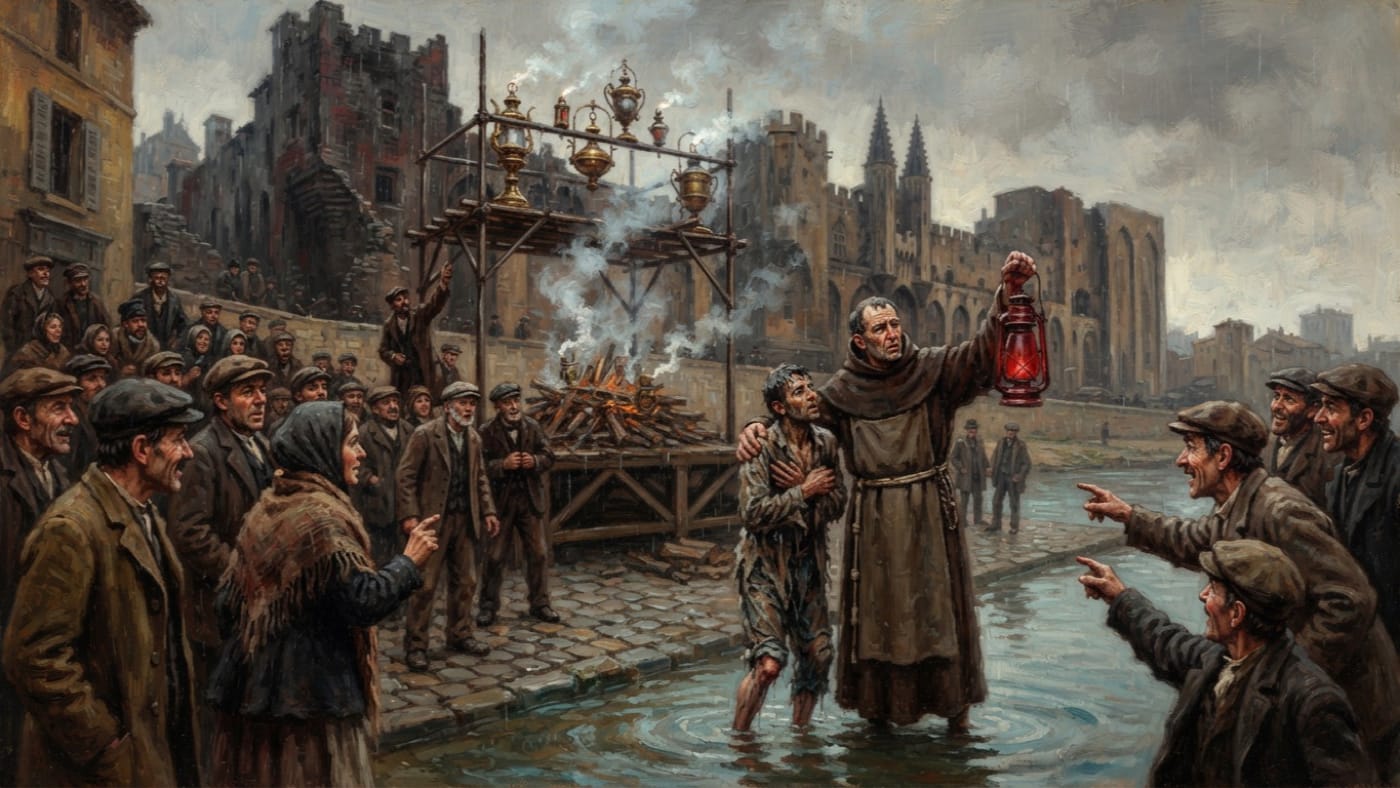
Avignon supplied drizzle. The catalogue does not say how long it fell or how heavily. It says only that it was enough. The reliquary lamps sputtered, and where the crowd expected flame they produced steam.
Picture it from the street. A crowd gathered to watch the Creator's fire come down on a guilty body, and instead it watched holy vessels hiss like kettles. Steam carries no doctrine and points nowhere. It never rises in a column a child could point at. It drifts sideways and joins the weather. In the catalogue's flat wording, the lesson was lost to rain.
The whole art of Ephrath is deciding what a crowd does with attention it has not yet spent. The Avignon crowd did the worst thing it could have done. It began to chant an old Rationalist slogan, which the longer account records as Man Alone. The Republic's schoolmasters once taught those two words as the sum of philosophy. The Church has taught them ever since as the sum of damnation. Two words are easy to shout in the rain.
The account has limits, and they bind me as tightly as they bind any provincial preacher. A borrowed slogan does not make every voice in that street a Rationalist. It does not make the culprit one either. People pick up whatever tool is closest, and a cheated crowd picks up the closest insult. The account records no riot, no charge, and no cordon. It records the chant and a Prior who understood that the next moment would belong to whoever acted first.
#On the River Improvisation
The Prior's name is not recorded. He cut the culprit loose.
Consider what that did. An execution that has failed leaves a living man in restraints, and he stands there advertising the failure to everyone present. Once released, he advertised a different thing. The Prior then led him into the river. The account gives no more detail than that, and I add none. I will say that it was an elegant choice. Water had ruined the lesson, so the Prior walked into more water, as if he had chosen the element all along and the drizzle had only arrived early. That is my reading of what he did. The record says only that he did it.
Then he raised a crimson lantern that did not burn. "Behold," he cried, "a miracle of restraint."
This is the centre of the account, and it repays slow reading. A lamp that fails to light is an embarrassment. A lantern that is deliberately kept unlit is a claim. With one sentence the Prior turned the failure of the flame into a choice not to use it. In his telling, the Creator had not been prevented from burning anyone. The Creator had declined to. The lantern was crimson, the colour of the fire the crowd had been promised, and it was held up empty so everyone could see what was being withheld. Every brother of that Order is trained to judge how long a pause should last before the crowd starts to pity. The Prior had to judge it in drizzle, in a river, against a crowd that was chanting. He judged it correctly.
The account leaves the two men in the river. It does not say whether the culprit came out, whose custody he left in, or whether his release lasted beyond the moment it served. Some readers want endings. Those readers should take up novels. I will not finish a sentence the catalogue chose to leave unfinished.
The crowd laughed, and the slogan stopped.
Laughter is not conversion, and I will not pretend that it was. The account does not say what the crowd was laughing at: the Prior, the lantern, the wet culprit, or itself. The answer does not matter. A crowd cannot laugh and chant at the same time. The laughter pulled every eye back to the brother holding the lantern, and the old slogan was left lying in the street. Ephrath had lost its lesson and recovered its audience.
#On the Filing of Failure
The Prior was promoted. The account does not name the office he received, the rank he reached, or the hand that signed the order. Those details belong to a file this survey has not seen. I will not imagine its contents.
A lesser Order would have buried the episode, as the Shroud buries everything, with a straight edge and a pot of paste. Ephrath kept it. The Cold Fire sits in the catalogue its senior brothers recite below Zaragoza, among their other disasters. It is studied as a failure that did not finish failing.
The Avignon incident is filed as the Cold Fire.
A stamped erratum renamed it: the Avignon incident is henceforth "The Miracle of Cool Ash." There was no ash. There was barely any fire. Accuracy was never the purpose of the erratum. The new name moves the event's centre away from the lamps that failed and onto the lantern that was held up, which is exactly the move the Prior made in the river. The Order's own catalogue still uses the old name. Brothers who have stood in wet streets prefer the honest one.
ORDER OF SAINT EPHRATH — INTERNAL MAXIM, NINTH REVISION: FAILURE IS INSTRUCTION WHEN FILED BEFORE RUMOUR ARRIVES.
I do not claim that Avignon produced this maxim. The record makes no such connection, and the Ninth Revision is a document revision with no date attached to this case. The maxim and the incident fit each other, and that is all I claim. A Prior who turns a ruined burning into a story about mercy before the crowd disperses has filed his failure before rumour can. He wrote the official version while the unofficial one was still forming.
#On What the Record Establishes
The record establishes the following. In Avignon, a city now lying in penitential ruin, a street execution using reliquary lamps failed in drizzle. The crowd took up Man Alone. An Ephrath Prior freed the culprit, led him into the river and raised an unburning crimson lantern as a miracle of restraint. The crowd laughed, the slogan ended, and the Prior was promoted.
The record does not establish any of the names, the offence, the year, the street, the number of people watching, or what happened to the culprit. It establishes no cold flame. Avignon's separate schism has its own file and contributes nothing to this one.
The Prior did not save the lesson. He replaced it, in the rain, with a lantern he could not light, and the Order still recites what he substituted. As doctrine, it is sound. As stagecraft, it is superb. It was also, by every account, very wet.