
#On the Ground That Remained at War
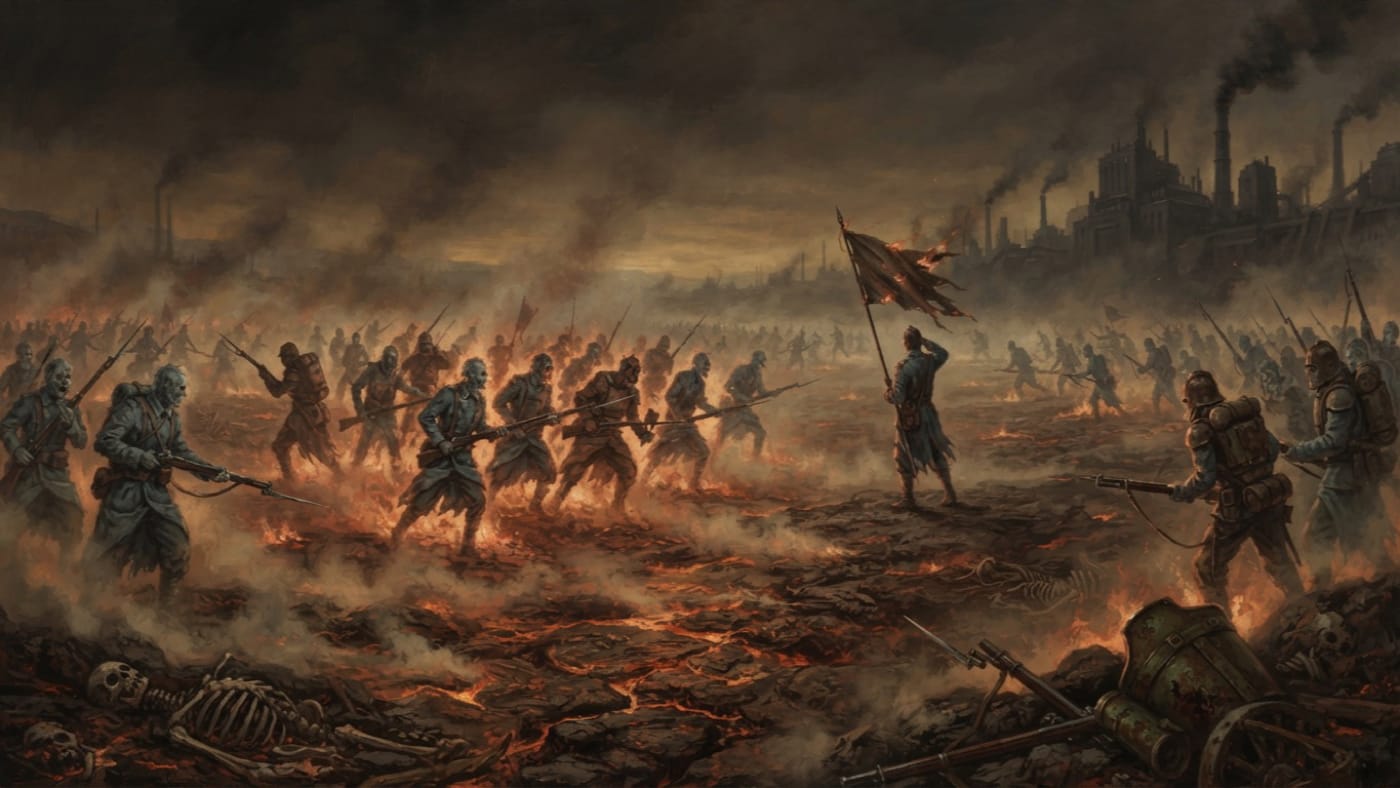
The Char Fields lie within the Iron Wastes of Thrace, north of Bastion-Constantinople, in the domain of Maldrake, Sin-General of Wrath. They are battlefields. The fighting on them has not been told.
This dossier is dated A.S. 181 (1891 CE). That is the year the Bureau of Records tried to identify the figures in the fire, and the year it gave up. The date belongs to that attempt. It is not the year the ground first burned, and it is not the year of any battle fought there. It establishes only that by 181 the Church had seen enough of the fields to send a clerk. When the fighting began, and whose war it was, I cannot certify. I have certified the dates of things that never happened, so my reluctance here tells you how little the evidence holds.
The descriptive account of Wrath's territory says that thousands died in these places, that their rage pooled in the soil, and that the ground caught fire from it. The Maldrake dossier repeats the account almost word for word. I record it as the account. No thermometer in Bureau service has survived a conversation with the Wastes, and I will not invent one to make the explanation look measured.
#On the Figures in the Fire
Figures move through the flame, and they are fighting. On that much the sources agree. They disagree about how long. The descriptive account says the battles ended centuries ago. The Maldrake dossier says a century. I will not subtract either figure from 201 to produce a year. Wrath keeps a poor calendar, and on this occasion so do we.
The account says the war continues whether an enemy is present or not. It says the figures do not notice they are dead and cannot stop. These are claims about the inner life of men no confessor has heard, and I enter them under the source's name. A cleric who claims to know what the dead are thinking had better be a saint or a liar. The Bureau keeps plenty of the second kind and has none of the first to spare for Thrace.
What the figures wear is a matter of record. The Iron Wastes dossier reports three kinds of dress. Some fight in Rationalist blue-grey. Some fight in what that dossier calls early Synod rags, a phrase written after the fact: the formal Synod was settled at Strasbourg in A.S. 90, and whoever wore those garments was dressed by an institution that had not yet earned the name, or by one that had already lost the tailoring budget. Some fight in armour that no human army is known to have issued.
The rest of the scene I take from the general signature of Wrath's ground, which the field reports confirm across the whole territory: heat shimmer that makes every outline doubtful, smoke that crawls along the ground instead of rising, and the noise of battle carrying on after the battle is over. The palette of Wrath allows no cool colour. The blue-grey is there anyway. Even Hell, it appears, cannot get the Rationalist uniform out of the laundry.
#On the Attempt at Identification
In A.S. 181 the Bureau of Records sent an observer to the fields to identify the dead by silhouette.
It was a modest method, and I respect it for that. Flame does not leave a face to read. A silhouette offers the cut of a coat, the crest of a helmet, how a man carries a pole or a pike. From such things a clerk may guess an army, and with luck an era. A silhouette will never yield a name. Records knew this when it chose the method. It went for the garment because the garment was all the fire would give.
The Iron Wastes dossier records how the attempt ended. A dead standard-bearer turned and saluted the observer by name. The effort was abandoned.
That is the whole record, and I will not make it longer. The account does not name the observer. It does not give the name that was spoken. It does not say whose standard was carried, which unit, or which battle. It describes no inquiry afterwards, no report of anything recovered, and no fate for the observer beyond the end of the work. Others have filled gaps like these with dialogue and a widow. I have filled a great many myself, for pay. This one I leave open, because I have nothing true to put in it.
One point I will press, as a professional grievance. The Bureau of Records exists to attach names to things: names to births, to tithes, to the dead, to the condemned. It sent a man into the fire to collect names, and the only name the fire produced was his own, and it was handed to him by the man he was there to catalogue. The procedure had run backwards. Records has no form for that.
The account also leaves a contradiction for the reader. The descriptive source says these dead do not notice their deaths. The Iron Wastes dossier says one of them knew a living clerk well enough to salute him. I set the two side by side and do not reconcile them. Any reconciliation would require me to know how the dead remember, whether something else was speaking through the standard-bearer, or who he was. The Church has authorised no answer to the first two questions, and the third was abandoned in 181.
#On the Descriptions Entered Against Them
Three institutional vocabularies have been aimed at the Char Fields, and none of them hits.
Records describes them by appearance: blue-grey, rags, unmatched armour. It assumes that a uniform leads to an army, an army to a muster roll, and a muster roll to a man. In 181 that chain broke at its last link, and it broke the wrong way.
The Wrath account describes them by cause: rage that outlived the bodies holding it and settled in the ground as fire. This explains a great deal and cannot be checked. Doctrine finds that combination comfortable.
The Bureau of Engineering has nothing to say about the Char Fields themselves. In the sources I hold there is no Engineering survey of the fields and no Engineering classification of them. Its language comes from the Wastes in general. A surveyor sent in A.S. 189 to measure the thermal gradient at the western edge reported that his instruments melted before he could take a reading. The Bureau described the ground's cracking and re-forming as "seismically unprecedented." Field officers called it angry. I quote these to show what a measuring office sounds like when it reaches this part of Thrace, and I make no claim that any of it was measured on the fields.
Records looks for names, the Wrath account names a cause, and Engineering reports that its instruments have melted. None of them has yet entered a description of the Char Fields that the fields would recognise.
#On the Other Works of Wrath
The Char Fields are easily confused with the other works of Wrath, and the confusion should be refused.
The Crucible Cities are urban places where human beings are refined into weapons over years. The Eternal Forges are mountain complexes that produce arms in quantities no army could use. The Burning Trenches move forward through the ground, attack, and must be fed. The Char Fields stay where the battles were. They share a domain and a master with the other three and do none of their work.
Maldrake commands a true army, and the Maldrake dossier is clear that this army's violence needs direction: without his will, his forces would turn on one another. The figures in the fields are said to fight with or without an enemy. That much resembles an army left without orders. It does not show that they belong to his.
The same dossier describes the Raging Dead, warriors of ash and ember held together by rage, who re-form for as long as the anger lasts. The resemblance is obvious, and I note it. Neither source says the figures in the fields are Raging Dead, Ember-Soldiers, or any other enrolled part of Maldrake's host. A resemblance cannot be filed as a recruitment record, and the Bureau of War would not accept one if I tried.
#On Their Reported Present Condition
The Maldrake dossier, sealed in A.S. 201, reports that the Char Fields still burn and that the figures in them are still fighting. Its closing passage says the fields burn with the rage of soldiers who have not yet consented to stop. I give that report as the dossier's, under its date.
The Iron Wastes dossier, under the same present date, reports that the Wastes are expanding toward Constantinople. It does not say the Char Fields are expanding, and I will not let the greater territory lend its rate of advance to the lesser. A field that grew would no longer be a field from the old battle. It would be a new one, and somebody would need to be dead in it first.
There is also the night testimony. The Maldrake dossier records, second-hand, men discharged from front-line service for "theological fatigue" who said the fields are beautiful after dark and that the figures move with a grace no living soldier achieves. I have no names for these men and no count of them, and I will not supply either. Their complaint is the most informative entry in this file. They went out to watch a war of the dead, and the war was not what troubled them. The grace did.
The entry stands as the evidence allows: battlefields in Thrace that still burn, figures still fighting in them, and one attempt in A.S. 181 to put names to the dead, which ended when one of them put a name to the observer. The Ledger has a column for that. It is headed Unestablished, and I have kept it in good order.