
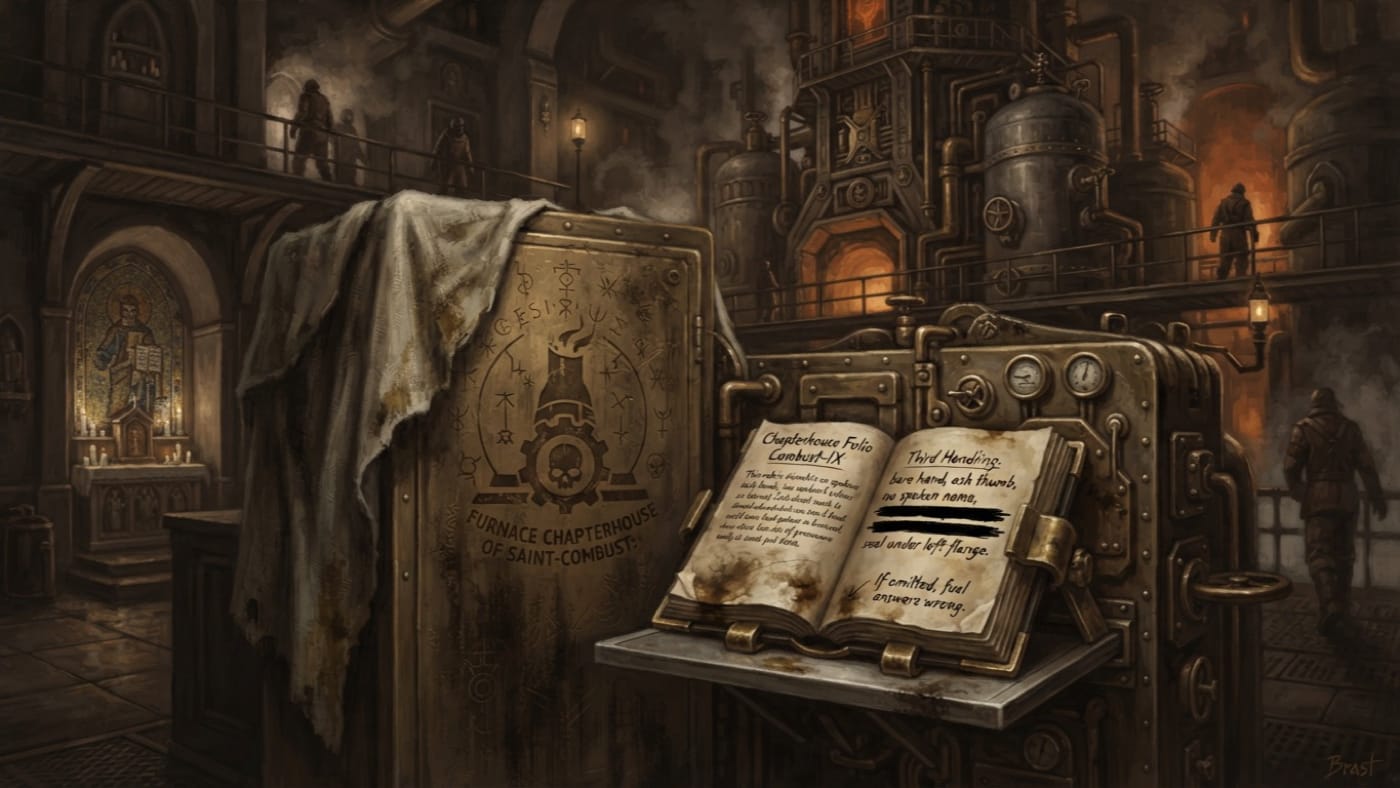
#On the Folio's Custody
Chapterhouse Folio Combust-IX governs a few seconds of a furnace-feeder's morning, and the Furnace Chapterhouse of Saint-Combust guards it as though it held the deed to Brast. Perhaps it does. The Chapterhouse would never put such a thing in writing, which is how one knows it has considered the matter.
The folio lives in the eastern furnace archive, behind the eastern furnace chapel and within the jurisdiction that also holds the Kiln Three shrine. The archive keeps its papers in brass cabinets under asbestos cloth, cross-indexed by kiln, bell and stain. Confession slips, accident prayers, substrate blessings, heat anomalies, misfire petitions and the last statements of workers lie there among Choir complaints, Compact receipts copied from memory, and the denials of Engineering. Somewhere in that soot-dark sediment of fear and filing sits Combust-IX. Access runs by rite, heat rank or inquest warrant. No special rule for this folio has been published. In Brast that means only that nobody has yet needed one.
The Bureau knows the document by excerpt. Its author is unrecorded, and so are its date, its length, its binding, its original seal and any history of its copying. The Chapterhouse has shown no hurry to supply them. The numeral has excited the usual arithmetic among pious clerks. IX is part of a shelf-mark. It licenses no count of steps, volumes or anything else a nervous reader would like to number.
What the document does establish is ownership. Brast burns chrismole because certain things are done in a certain order by certain hands, and the Chapterhouse has made itself keeper of the order. A Distiller knows the grade of a drum. A gauge-scribe knows the temperature of a line. Only the priest knows which part of the morning is sacrament. Once a practical step is copied into a folio and shelved behind a chapel, it becomes liturgy. Once it is liturgy, it belongs to whoever holds the shelf.
#On the Third Handling
The surviving excerpt concerns the Third Handling of substrate before first-stage charge. The placement matters more than the name. The Chapterhouse's published bell-rites run in a public sequence: first-bell anointing precedes feed, second-bell confession precedes pressure rise, third-bell ash-scraping proceeds under black cloth, and fourth-bell silence belongs to the Calibration Choir. The Third Handling takes no place in that sequence by its own text. Its name invites the assumption that it belongs to the third bell. The folio does not say so, and I have learned not to lend folios my opinions.
Chapterhouse Folio Combust-IX records the "Third Handling" of substrate before first-stage charge. The rubric reads: bare hand, ash thumb, no spoken name, ████████████ breath, seal under left flange. Marginal note in a later hand: "If omitted, fuel answers wrong."
Five instructions, then. A bare hand, in a foundry where any man who values his skin wears leather to the elbow. An ash thumb, with no ash specified. The Chapterhouse mixes Kiln Three ash into the oil for certain valves, and it has declined to say whether that ash and this one are the same. No spoken name, without saying whose name, or whether it is forbidden to the handler, the witness, the substrate or the furnace. Then a breath whose description someone has blacked out, with the care usually given to a will. Then a seal under the left flange, of what kind and on which flange the rubric does not trouble to explain to anyone not already standing there.
The rubric is silent from beginning to end. It has no hymn, no litany and no tap on the lid. In a city where every licensed throat is counted, the one rite that touches the charge directly is performed with the mouth shut.
The marginal note is the most useful line on the page and the least reliable. Its hand is later, its author anonymous, its date absent. Its grammar will not say what may be omitted, whether the whole Handling or any single element of it. Its verb assumes something worse than its warning. Fuel that can answer wrong is fuel that answers.
The Third Handling is a lesser form of the first-bell anointing, performed upon the substrate rather than the vessel.
Corrected. The rubric names no oil, no bell and no vessel. Anointing is done to furnaces. The Third Handling is done with a thumb, before the charge, by a hand the folio declines to identify, and the Chapterhouse has not invited comparison.
#On the Hands Permitted Near the Charge
Every office in Brast owns a piece of the first-stage charge. None of them owns all of it, and each resents the others' share.
The Distillers' Compact owns the supply. Pex Ruln controls throughput, filters and still recipes, and the grey drums arrive by his schedule and under his seals. The Chapterhouse blesses those drums without naming what is in them, and Ruln accepts the blessing without asking what it does. Each party believes it has the better bargain. The drum itself is not consulted.
The Choir owns the song. Ilyra Kest and her licensed throats decide which calibration may be sung and when the valves have been sung into obedience. A rubric that forbids a spoken name and conceals a breath sits uncomfortably near Kest's jurisdiction, since nobody in Brast is quite certain where breath ends and song begins. The Chapterhouse has not asked the Choir's opinion. The Choir has not offered one in writing, which is how the Choir conducts its quarrels.
Commander-Auditor Sorn Vale owns the count. Vale audits manifests and punishes diversion, and a substrate handled by a bare hand before charge has been reached by someone, at some moment, through some seal. An auditor sees a procedure and asks where the drum was opened and who was standing there. The Chapterhouse answers that rites are not inventories. Vale's interest in the eastern archive is a matter of record in the Chapterhouse's own profile. Whether that interest extends to this folio is a matter of speculation, and I leave speculation to the Manifest Court, which bills for it.
None of this proves that Ruln, Kest or Vale has read Combust-IX. It proves that each needs what it governs and that none may govern it. That is the whole of the Chapterhouse's power: a procedure every office depends on, held by the one office that can call its secrecy devotion.
#On Fuel That Answers Wrong
Brast lives beside machines that misbehave as though offended. Valves stick in spite. Gauges answer hymns. Boilers hiss syllables, cannons fire long or short, and trains stall mid-switch with the sullen air of clerks denied a holiday. The city calls them the Sulking Engines, and two Bureaus have each produced an explanation that fits its own budget.
Engineering speaks of harmonic interference, pressure irregularity and responsive material fatigue. It filed the death of Kiln Three as an Acoustic-Mechanical Disturbance. The certification later carried under the seal of the Bureau of Doctrine called the same event "consistent with martyrdom," and the Chapterhouse teaches that machines in long contact with sanctified fuel and correct rite acquire a rudimentary spiritual awareness. Since the Concordat both positions have shared a city, and the shrine at Kiln Three still keeps its warmth.
The marginal note fits both readings and confirms neither. To Engineering, "answers wrong" describes a material reacting badly when its preparation is skipped: a contaminant, a temperature, a breath carrying damp to the wrong place. To Doctrine, it describes a sanctified substance refusing an improper approach. Both readings make the Handling necessary. The Chapterhouse needs nothing more, and it has never asked anyone to choose between them.
There is a third reading, which the custodians do not write down. A rule can be kept because the custodians know what happens without it, or because they fear it, or because the thing it governs would rather not be named. The rubric forbids the name. The blacked-out phrase covers the breath. The later hand wrote "fuel" and stopped there.
Clerks of a nervous disposition have asked whether the folio is warm to the touch. It is paper in a furnace archive. Everything in that room is warm.
#On the Present Custody
In late A.S. 201 a new class of paper entered the eastern archive. A furnace-feeder on night ash-scrape confessed to hearing a hymn from behind Kiln Three that named Saint-Combust Brother Furnace. The Chapterhouse's own record states that his slip grew hot in the confessor's hand. Further reports followed from the Still-Canals and the Boiler Commons. The Chapterhouse declared a containment fast, doubled the censer smoke and burned seven hymn slips copied from memory. Those slips now lie, in ash or index, a few cabinets from Combust-IX.
The hymn's words are not found in the folio. The folio offers nothing about the hymn. The rubric forbids a spoken name, and the hymn offers the furnace one. The archive holds both documents, and only the archive has had the opportunity to compare them.
Lux Thane Mire has been sent to Brast, or is expected there, depending on which office's correspondence one trusts. His examination has not begun in any record available to the Bureau, and his verdict is not to be anticipated in print. An inquest warrant opens the archive. It does not tell the warrant-holder which cabinet matters, and the Chapterhouse has every reason to let him find the answer for himself, slowly.
Meanwhile the Third Handling continues. Each morning before first-stage charge, a bare hand takes ash on its thumb, keeps silent, breathes as instructed and seals under the left flange. The furnaces of the Chrismole Crown burn. The drums go east. Whatever the fuel would say if the step were skipped, Brast has arranged its industry so that nobody needs to hear it.