
Hold release confirmed (29 Sept) and sources checked; writing the tract now.
#On the Book's Office
"A clean note is a clean burn."
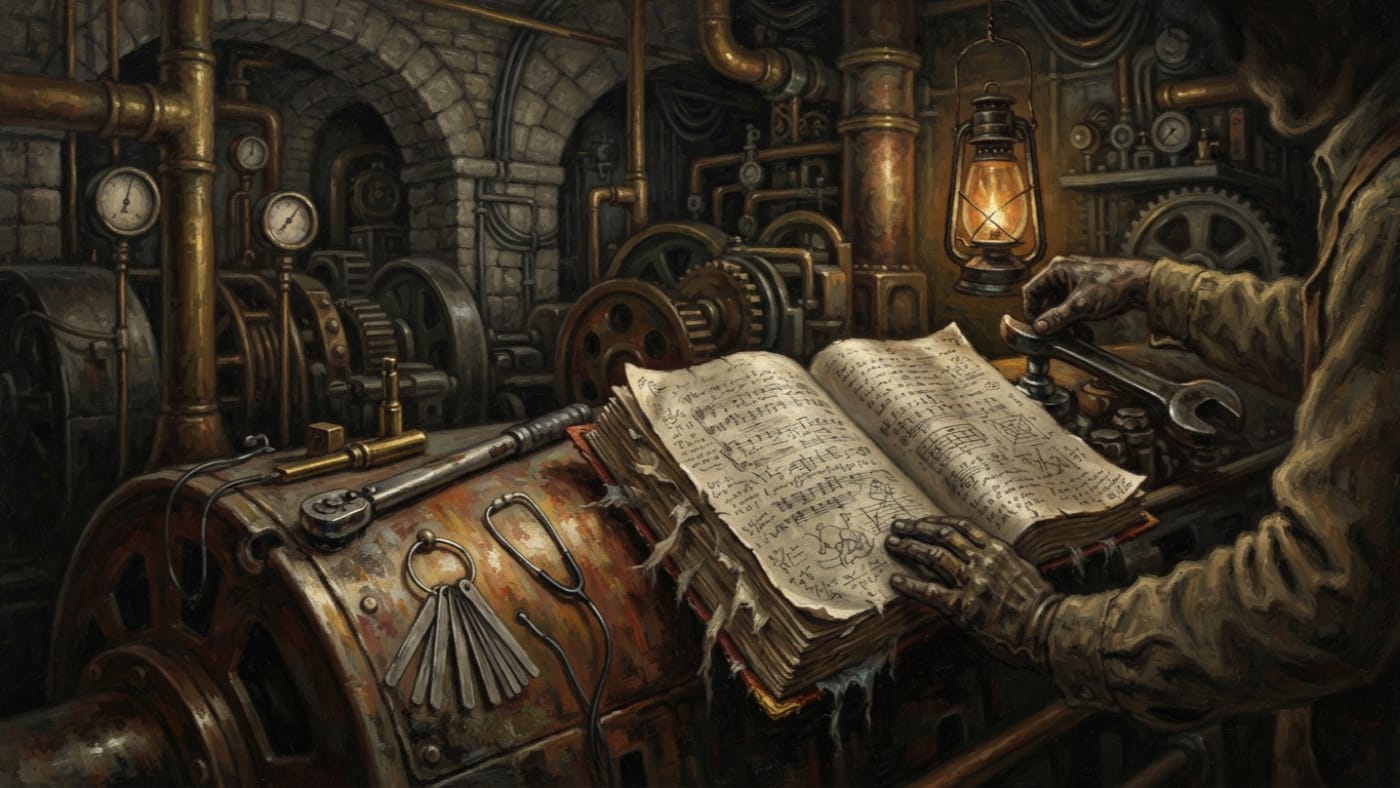
The Litany-Engineer signs for six instruments on licensing day: torque wrench, feeler gauges, stethoscope probe, timing light, seal punch and chant codex. Five of them measure the machine. The sixth measures the man, and it is the only one an auditor can quote back at him in a tribunal.
The chant codex is the working reference for engine cant, the spoken and sung sequences that the Bureau of Engineering lays against an engine's RPM bands. It tells the operator what belongs in his mouth while his hands are setting the timing. The Bureau's position is that a correct clearance spoken in the wrong interval is an incorrect clearance. A mechanic needs a number. The Synod requires the number to be prayed. The codex is where those two demands were bound under a single cover, and the binding has outlasted most marriages contracted under Synodal licence.
Nobody should picture one great Book chained to a lectern. There are as many chant codices as there are licensed hands to carry them, and several more than that. No original manuscript is shown to pilgrims. No compiler is venerated. Saint Edrin of the Eight Strokes, patron of the trade, is painted holding a wrench like a censer, and the Bureau has never claimed he held a pen.
#On the Sanctioning of Cant
The cant came before the book. During the Great Retreat of A.S. 48–65, field operators noticed that engines failed in patterns that had nothing to do with wear. They also noticed that sound mattered. Certain rhythms steadied combustion and certain intervals choked off the wrong tones. These operators carried no codex. They carried a crew chief's hum, chalk marks on a housing and the memory of the last man who had got it wrong. Later histories call them the first Litany-Engineers. Back then they answered to whatever name the convoy sergeant shouted.
Their offices formalised the practice in stages, as offices do. The formal Synod itself was not constituted until A.S. 90, so every earlier "sanctioned" melody is sanctioned in retrospect, which is the most comfortable way to sanction anything.
The Black Start Catastrophe of A.S. 97 settled the matter. An unsanctioned restart at the harbour of Bastion-Brest set half a port alight. Standing Order 14-E then made cant-certification mandatory for every operator on a licensed machine. The Ledger does not record when the first chant codex was stitched, by whose hand, or whether the texts that certified candidates in A.S. 97 looked anything like the copies issued today. It records only that certification was required from then on, and that certification requires something written down against which a candidate's mouth can be checked.
The Furnace Choir Reforms of A.S. 134 standardised litanies across all bastions and outlawed folk tunes in motor houses. A melody that differed from Brest to Irongate could no longer be certified. Pages drifted toward sameness under that pressure, the way a congregation drifts toward the cantor who carries the stick.
#On the Substance
The codex sets cant to operating bands: what is sung at idle, what is spoken under working load, what interval must hold while the machine takes real draw. Calibration runs alongside it. While the operator sets timing, mixture, pressure, belt tension and valve clearance, the codex supplies the words, and the feeler gauge decides whether those words were worth saying. A man who has the cant by heart and a seized valve has achieved a hymn. A man with a true valve and the wrong interval has achieved a disciplinary hearing.
Three objects get confused by visitors, and confusing them is a matter for the auditor:
- The chant codex says what must be said.
- The maintenance ledger records what was done: the measurements, the cant code and the witness signature.
- The litany plate is the etched tag fixed to the machine, certifying its sanctity to anyone who comes after.
The sources show these three working together at every inspection. They do not show the three bound into one volume. When auditors arrive, they listen first, then compare the cant codes in the ledger against the RPM bands the machine is actually running. The codex is the authority both of those are measured against. That makes the book a witness for the prosecution in every audit, whoever happens to be carrying it.
The working copies are the documented property of a profession that works in sumps. The field hymnals of Synodal engineers are described as oil-stained, water-warped and torn at the corners by hands with no time to be careful. Their margins are crowded with calculations where an illuminator would have put saints. The Bureau has not certified that every demolition hymnal pulled out of a collapsed tunnel was a chant codex. It has certified that the margins look the same.
The book has cousins and should not be mistaken for them. Irongate exports licensed "pressure hymnal" copies alongside its gaskets and valve plates. The Gasket-Hymn Mechanic torques seals to his own rite sheets. The Diesel Resonance Plumber answers for fuel lines and resonance pipes, which the codex is under no obligation to cover. And the Furnace Catechist stands over all three, deciding which explanation of a failure may be spoken aloud.
#On Its Application
Take a generator in a stone vault at the end of a shift, any bastion, any year. The operator comes down the ladder into the diesel film and the lamp-tremble and puts the stethoscope probe to the casing before he touches anything else. He listens for harmonic drift, a knock, any undertone that does not belong.
Then the codex comes out, propped open on the housing where heat has already curled its edges, and the work begins. The wrench clicks at specification. The feeler gauge slides and drags. At each band the operator gives the cant prescribed for it, his throat already raw from the last vault, and the engine settles or it doesn't.
Seal verification follows: the litany plate checked for tampering, the wax stamp pressed, the chalk wards renewed. Some of the chalk is measurement and some is ward, and the operator stopped caring which was which years ago. The machine is then load-tested under real draw. An engine that holds a clean note at idle and screams under load has lied, and the codex has nothing to say to liars except the next line.
Last comes the ledger. Numbers, cant code and a second signature. Nobody sanctifies alone, because a man who restarts a generator alone and dies leaves no record of what went wrong. The Bureau grieves the man in due course and the missing record at once.
At Irongate, local ordinance forbids whistling, which is said to destabilise the valves. The calibration whistle that every Litany-Engineer carries elsewhere is useless there. In those vaults the codex is the only pitch a man may carry openly.
#On Corrections and Forbidden Tunes
Codex Purists demand the full sanctioned sequence for every operation: ignition litany, calibration cant, closing hymn, seal, witness. Field Pragmatists shorten it whenever a convoy is idling or a pump room is flooding under bombardment in No-Man's-Land, since a skipped psalm kills fewer men than a dead generator. Both sides carry the same book, and they disagree about how much of it a man is allowed to leave unsung.
Choir-trained engineers learn the cant from the page in the training sheds of the Bureau of War and the Bureau of Engineering. The "earborn" learn it in trenches, by imitation, long before anyone issues them a copy. An auditor's transcript can tell the two apart. The engine, regrettably, often cannot.
Below both factions are the shadow repair rings in the Warrens and the rear-area motor pools. They keep alive tunes that are on no page: wild pitch, motor-house folk melodies the Reforms of A.S. 134 abolished, intervals that work and are therefore forbidden. They take payment in fuel chits, clean filters and silence.
The "Quiet Engine Heresy" of approximately A.S. 147 was formerly classified as a minor doctrinal irregularity.
That classification has been revised. Operators of the Quiet Engine sect claimed stable combustion by calibration alone, with no cant at all. The Bureau of Doctrine suppressed them with the Bureau of Purity's cooperation. Their notes were seized and their members reassigned to the Paper Mines. The Bureau of Engineering kept copies of their calibration data. No source records whether any of those figures were ever copied into a chant codex, and the Bureau of Engineering has declined to clarify.
The contradiction sits on the page. A book whose authority rests on the claim that the cant does work was revised under pressure from men who said it did not, and the figures they produced were kept.
#On the Present Use
In A.S. 201 the chant codex is still issued, still audited against, still propped on housings from the forward pump rooms of the Sagittal Line to the rear foundries. Standing Order 14-E was revised again in A.S. 199. That same year the Bureau of Purity directed that all reports of "foreign harmonics" be filed under Classification 7-K. The book was not reissued, and no edition bears that year.
Field reports keep coming in of motors that answer back with a tone the codex does not contain. It sets teeth and glass vibrating, and the operator has a few seconds to drown it out with whatever the page offers. Doctrine files these under Classification 7-K. Engineering calls them a measurement problem. The engineers call them nothing, at least where a witness can hear.