
#On the Office That Measures Corners
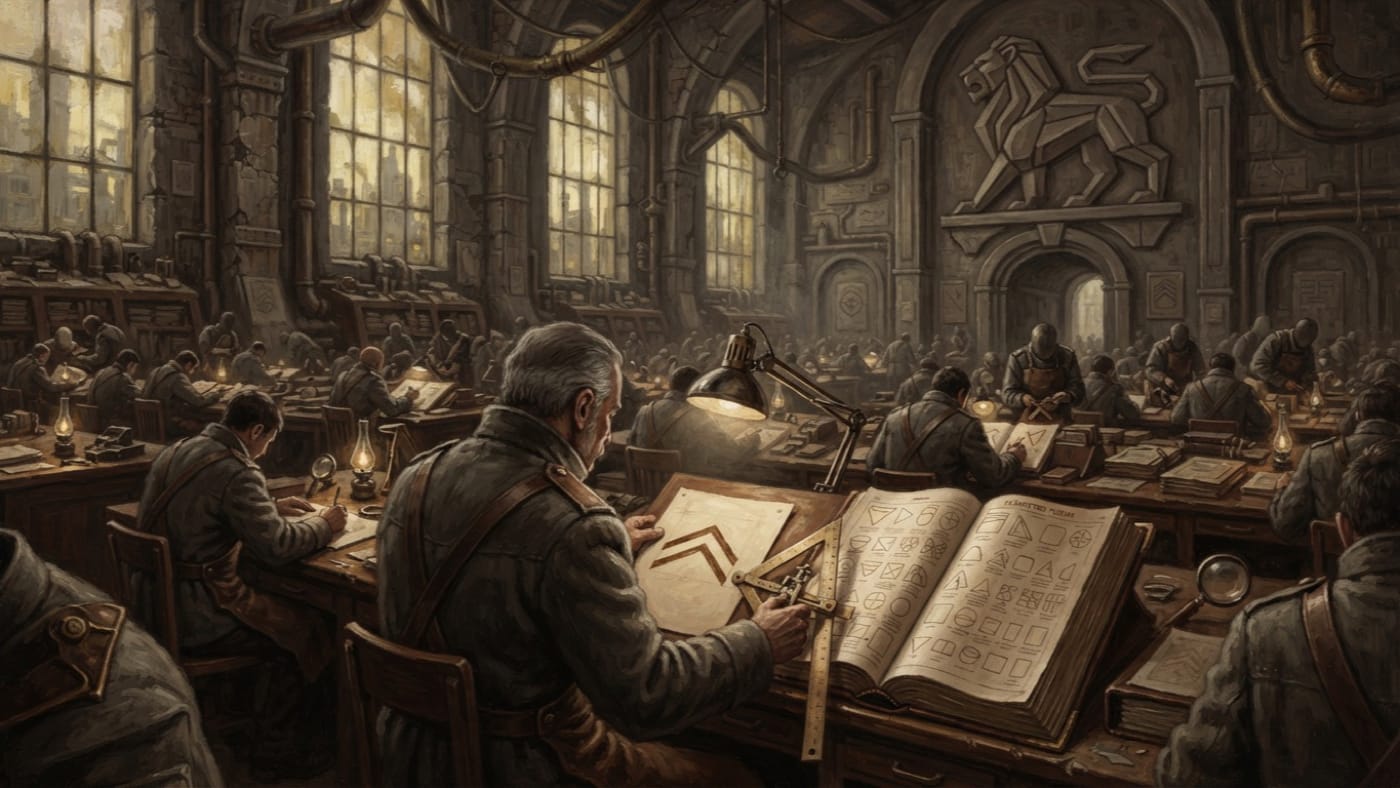
A chevron lies on a clerk's table in brown ink on a geometry sheet. Its two arms meet at an angle somebody will have to call lawful. The petitioner who drew it is a widow, a magistrate or a ferry company, and that matters a great deal. Until the angle has been compared, sorted and pronounced upon, the chevron may appear nowhere.
The Chancellery of Permitted Forms is the office of the Bureau of Heraldry that decides when a shape may appear. Hue belongs to the Chancellery of Colors. Registration belongs to the clerks of the Armorial of the Faithful. Scraping belongs to the Sigil Inspectors. The Chancellery keeps the line itself: where it bends, where it closes, which way it points, and whether its point has been forgiven. Forma sequitur licentiam. The form follows the licence, and never the other way round.
#On Lawful Geometry
A bend may descend at one of seven sanctioned angles. The degrees are kept in the Chancellery's tables, and I will not print them, because a printed angle is a copied angle and a copied angle is soon a smuggled one. The eighth angle is not a variation. It is an argument.
A chevron opens according to the class of its bearer, the bearer's grief status, or the bearer's proximity to the Sagittal Line. Two chevrons may be drawn with the same ruler by the same hand on the same afternoon and still differ in law, because one belongs to a mourning household and the other to a depot near the front. The citizen sees two roofs. The Chancellery sees a widow, a quartermaster and a fee.
The circle is permitted when broken, enclosed, haloed or assigned to a relic office. In the Bureau's theology, a free circle encourages unlicensed completeness: a closed line claims to want nothing, and Heraldry has never met a surface that truly wants nothing. Break it, fence it, crown it or give it a reliquary to guard, and the circle becomes a humble shape that knows its station.
Spirals are suspect. Suspicion is a docket, not a verdict, and the carvers' own sanctioned patterns include spirals that have survived review. They survived because each was examined first. Natural curves require review as well: the vine on a vintner's board, the wave on a ferry tag, the curl of hair on a saint's processional banner. A vine may climb a guild sign only after the Chancellery is satisfied that it has no ambitions.
A triangle is safe until inverted. Two triangles may be devotional, punitive or both, depending on whether the lower point has received absolution from the Chancellery. I find this the most beautiful sentence in Heraldic law. It grants a corner the capacity for sin and then reserves the forgiveness of that sin to a single desk.
At the centre of everything sits the Triune Knot. It currently has forty-three authorized variants, and every one of them measures true. A knot that looks like one of the forty-three is merely a resemblance, and the Chancellery has never accepted resemblance as evidence of anything except intent.
#From Sheet to Stone
The petitioner's ordeal belongs to the Armorial as a whole. It involves seven forms, three endorsements, a wax impression, a colour proof, a geometry sheet and a fee assessed by Tithes. Of these instruments, the geometry sheet is the one on which the Chancellery's eye rests. The represented shape is drawn and submitted. It is compared with permitted geometry, and a determination is made. The determination then travels into the Armorial entry, where it sits beside colour, material, scale, province, motto and approved occasion.
Each requirement stands alone. A lawful form in an unlawful crimson is still unlawful. A form approved for a funeral lozenge has been approved for a funeral lozenge and nothing else. The petitioner who carries a cleared chevron from a coffin plate to a tavern board has cleared nothing, and will learn this from a grey coat.
The geometry then descends into labour. The gate-carvers work from approved stencil frames and measure with the tri-cord, three knotted lengths for spacing and proportion. They cut knots into doors, lintels, graves and ossuary niches, then tag each mark with registration wax. Their apprentices learn that wet cord lies. Their masters say geometry cannot be bribed. In the same trade, a bribe is called "oil for the cord."
Carvers will not cut a knot with one loop facing down. The hanging loop, they say, invites the dead to stand. The Chancellery records no such mechanism. It records the loop.
#On the Baker's Pretzel
The Chancellery once spent nine weeks debating whether a baker's pretzel sign constituted a looped heresy.
Consider the object. A pretzel has three openings and arms that cross. The Triune Knot has three loops. A layman sees lunch. A clerk sees an unregistered variant of the Synod's most protected mark, hung over a doorway, rendered in dough-coloured paint by a tradesman with no stencil frame and no apparent fear of the forty-three. A trained eye sees both, and the trained eye is paid to prefer the second.
For nine weeks the question remained open. During those weeks the baker kept a shop and an oven and lost the use of a sign. Somewhere in that interval the baker was fined for impatience. The sign had not yet been judged.
The account that reaches me gives no name for the baker, no town and no year, and it records no verdict. I have searched for the determination and found only the fine. This is a perfect record. The single matter decided with full confidence was the conduct of the person waiting.
#On Inspection and Correction
A desk decision has no edge until it reaches a street. The Sigil Inspectors carry it there in their seal-books, reference plates and swatches, with measuring cord in one pocket and a scraper blade at the belt. They verify geometry, colour and display context together, because a citizen's sign meets the law all at once. Against carvers' work they check stencil serials, compare the knot with registry notes and take chalk rubbings from doors to test line depth and proportion. Inspectors' slang for a bad shape is "feral geometry." Carvers' slang for a failed knot is "loose loop." Both professions are correct.
The consequences are graded. A first error in angle may draw a fine and a recutting order: the carver returns, the old line is ground out, and a new one is cut beside the scar. An unregistered display is a different matter. Display without entry constitutes visual sedition, and the scraper meets the wall the same afternoon. False seals, counterfeit muster badges and inverted Knots leave Heraldry quickly for the Index Damnatus, whose questions do not concern angles.
The beasts show how geometry corrects what it does not kill. At the Crimson Gate Riot of A.S. 106, a convoy's crimson boar was read as wrath, and eighty-seven died. Two years later the Beast Proscription entered the Armorial. Wolves and serpents were banned, bears were suspended, and the crimson boar was declared a heraldic heresy. Lions, eagles and stags were kept. They were reduced to stylized canonical forms, angular and chastened, with their curves trimmed into permissible lines. My Ledger does not say whether the Chancellery of Permitted Forms drew the new lions or only approved their corners. Every repainted lion since has passed under a ruler.
Older inspectorate instruction states that the crimson boar was already banned at the Crimson Gate Riot and that hundreds died.
Corrected. Eighty-seven died at the Riot in A.S. 106. The Proscription followed in A.S. 108. The boar was lawful until it became the reason for the law.
#On Present Authority
Casselius of Mainz holds the Bureau of Heraldry and the Bureau of Masks and Seals in personal union. Those are two Bureaus, one pair of hands and one signature that answers to both. Through Heraldry runs the authority over what may be drawn. Through Masks and Seals runs the authority over the instruments that authenticate the drawing. The Chancellery's angles sit inside that union like a bone inside a fist.
Standing Order 14-C subjects all visual insignia to Armorial registration and lists no exemptions. Quarterly supplements carry additions, withdrawals and reclassifications to the provincial inspectorates. By the time they arrive, they are already out of date, and they still bind. A citizen whose sign was lawful in spring may be noncompliant by summer and learn of it from the blade. Responsibility rests with the citizen. The mail coach is innocent, and so is the angle.
The chevron on the clerk's table has now been measured. Its owner will be told which sorrow it is permitted to express, at which angle, on which surfaces and on which days. Quod non est in tabula, non est in muro. What is not in the table is not on the wall.