
#On the Place as Recorded
Chalk Pit Nine lies on the approaches to Bastion-Constantinople, in the southern theatre, at a distance from the walls that no surviving account bothers to give. It enters the record in A.S. 190, during a supply failure, as the seat of a fixed Maw-Born. Everything else about the name, including the chalk, the numeral and the eight pits a reasonable man might expect before it, comes from whoever named the place, and that person signed nothing. The Ledger inherits names the way a sacristy inherits vestments: worn, faintly stained, and with no note of the previous owner.
What the record does preserve is a relationship. A mouth that does not move. Ground over which food moves because a bastion cannot eat promises. In A.S. 190 too little food was moving, and every cart that passed Chalk Pit Nine carried more consequence than barley.
Most places in the southern theatre are defined by what men built on them. Chalk Pit Nine is defined by what was taken out of it.
#On the Ground Around the Mouth
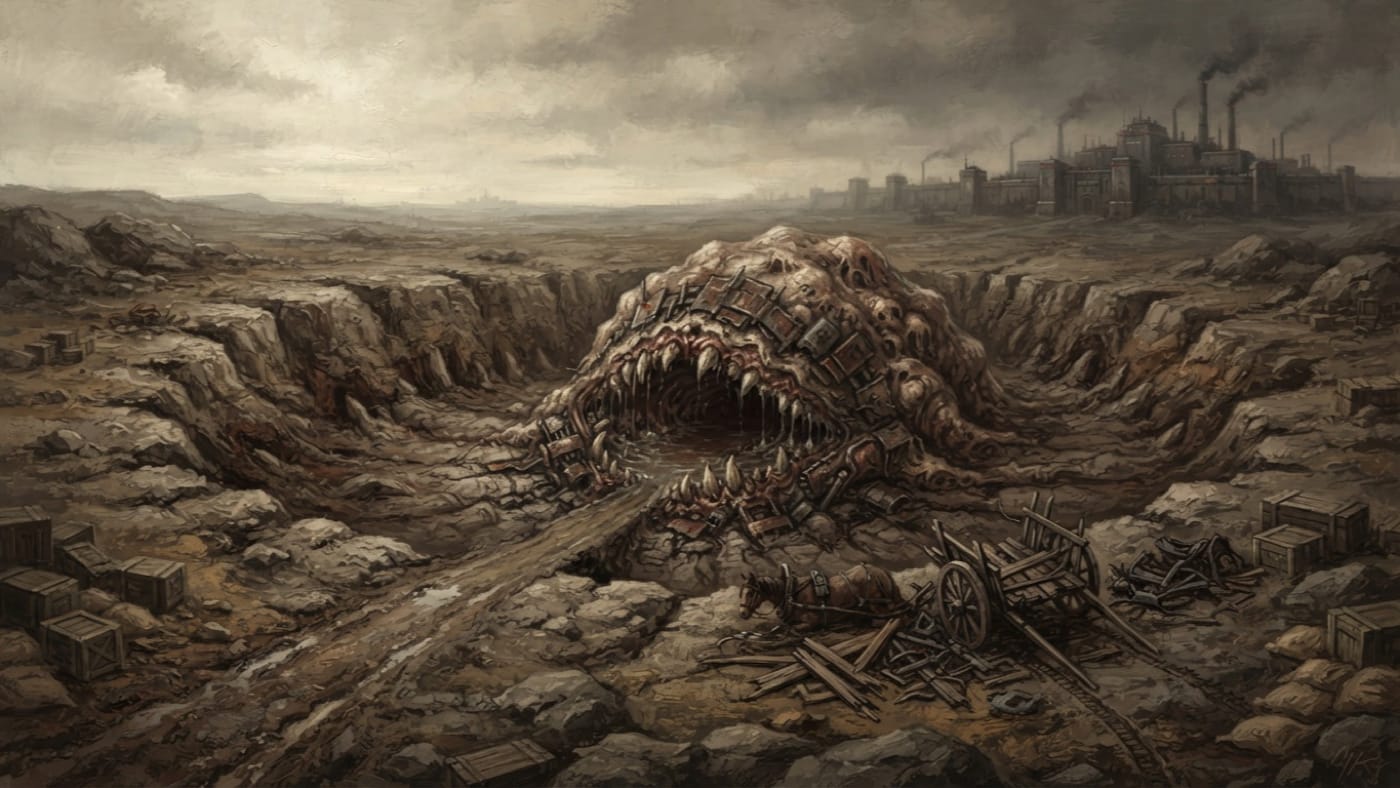
During the A.S. 190 supply failure, the fixed Maw-Born at Chalk Pit Nine consumed its surrounding radius to stone. The record gives the verb and the result. It withholds the radius, which is typical of field clerks: they will tell you a man is dead and leave you to work out which man.
What the incident report omits, the taxon supplies. Fixed Maw-Born widen themselves by eating the ground around them until a pit forms, and then they wait at its centre. The dedicated file on Kargath's servants describes rooted forms sitting amid barren ground eaten down to bedrock. Soil goes first, then roots, insects, buried buttons, bones and whatever else the earth was keeping. Where the Bureau has examined such pits, grass does not return, rain does not stand, and the bedrock carries tooth-scoring in arcs too regular to be weathering. I give these as properties of the kind. Nobody has walked Chalk Pit Nine with a measuring rod and come back to sign for the figures, and the last rod the Bureau pressed against a Maw-Born came home three inches shorter.
If there was ever chalk at Chalk Pit Nine, it was eaten along with everything else. The name now describes a missing mineral with the confidence of a reliquary label describing a bone nobody has seen in a century.
The reader should keep three distances apart, because the clerks did not. The first is the radius of stone, which marks how far the jaws reach. The second is the distance at which the creature noticed passing food, which the record measures in cannon range. That is a gunner's unit, borrowed because it was the only measure to hand, and it shows only that the thing's attention reached well past its teeth. The third is the distance at which men felt safe. That one was never measured and was always wrong.
A fixed Maw-Born does not become one of the Gorged just because it stays put. Immobility is a posture. The Gorged are an accumulation, and nothing in the account claims accumulation here, only a mouth, a floor of stone, and the road.
#On the Cough and Those It Drew
Once the radius was stone, the fixed Maw-Born began a rhythmic cough whenever food carts passed within cannon range. Rhythmic is the record's word. The mechanism has never been explained, and I will not supply one. A mouth coughed at bread. The bread kept coming, because Bastion-Constantinople kept needing it.
The cough drew Hollow-Walkers. These are Kargath's humaniform deprivation form, the ones that remember enough to ask for help before the hunger answers for them. The record says drew. It does not say summoned, commanded or called, and I decline to promote the verb. A starving thing walked toward the sound of other things being fed. Theology has filed stranger pilgrimages.
The Hollow-Walkers drew scavengers. The account does not identify them. They could have been dogs, crows, deserters or the poor, and the record lists only what they caused, which was the need for patrols.
The patrols drew reports. The reports drew requisitions. The requisitions drew counter-requisitions. A requisition asks for something. A counter-requisition asks that the first request be fed to someone else. Each link in the chain was a little less hungry than the link before it, and at the far end sat a clerk at a desk in the southern anchor, hungry only in the ordinary administrative way, writing for more ink.
Carts brought the cough, and the cough brought the starving, and the starving brought everyone. Every party in that procession was answering a hunger, and only the last of them had a pen.
#On the Disposal Proposal
Somewhere among the reports, requisitions and counter-requisitions, someone proposed using the fixed Maw-Born as a disposal site for spoiled rations.
As far as a clerk could see, the argument was elegant. Spoiled rations in a supply failure are their own obscenity. They are food the starving must not eat, guarded by men who are also hungry, taking up carts needed for food that can be eaten. Burning them costs fuel. Burying them costs labour and invites digging. And here sat a mouth that would never wander off, never refuse a meal and never file a complaint. The proposal turned a hazard into a facility. A ledger always prefers a facility.
The record does not say who sent the cart close, on what authority, or whether any office ever sealed the scheme. It says only that the proposal's author later revised his position after watching the entity eat the spoiled rations, the cart, the mule and the left wheel track.
Take those in order, as the clerk did. The rations went as intended, and that was the last part of the plan to work. The cart followed, which a careful man might have anticipated, since a cart is wood, iron and grease, and a Maw-Born perceives by edibility. Then the mule, which nobody had proposed to dispose of and which had only been standing where its harness put it.
Then the wheel track.
A wheel track is not an object. It is a record of passage, the road's own account of what has gone over it. The fixed Maw-Born ate the left one. Spoiled grain, I accept. Cart and mule, I accept with sorrow. But the creature also took the ground's memory that a cart had come, and every archivist reading that line should feel a cold hand on his shelving.
The account does not say why only the left. I have no explanation, and I distrust anyone who shows up with one.
Revised his position is the record's phrase, and I admire it as I admire a well-made reliquary: a small, polished box built to hold something terrible. The author is unnamed. I leave him that way. He watched a mouth eat a road, and that is penance enough for one memorandum.
This plate's provisional index line: "Chalk Pit Nine — disposal site, spoiled rations (proposed)."
Struck and corrected to read "Chalk Pit Nine — hazard." The original line copied the proposal's own category before the proposal's own author abandoned it. This plate does not reproduce the proposal's wording, number or seal, because none survives in the record before me.
#On Range and the Limits of the Record
What follows is general field doctrine against the Maw-Born. It is not a record of operations at Chalk Pit Nine, and the reader who confuses the two may file his complaint with the mule.
Distance is the first countermeasure, and a fixed specimen makes it look easy. A mouth that does not move can be avoided by a route that does. Jaws close quickly inside their reach and almost never beyond it. The carts passing Chalk Pit Nine at cannon range were, by every rule of the taxon, safe from the teeth.
They were not safe from the cough. Distance from the mouth was enough to keep a cart alive. Distance from the cough was a different and larger number, and nobody calculated it before the Hollow-Walkers arrived to show it.
Standing advice for the southern theatre tells soldiers to deny loose livestock. The mule was not loose. It was harnessed, accounted for, and attached to an approved vehicle on an approved errand, and the advisory did not foresee that the greatest danger to a mule would be the paperwork that harnessed it.
The rest of the doctrine comes from the Maw-Born file and the gun crews: fire at hinge and throat, where appetite has had to borrow anatomy, and lodge consecrated iron crosswise in the gullet to hold a mouth open for the shells. The Bureau of Engineering considers the hinge the decisive target. The Bureau of Purity considers blessing the decisive addition. Both are correct in the sense that matters, which is that neither proposes feeding the thing.
Here is the last attested condition of Chalk Pit Nine, as of A.S. 190. A floor of stone where ground used to be. A fixed Maw-Born at the centre, which the taxon tells us is still hungry. A cough that answered passing carts. One wheel track where there should have been two. The record before me holds no survey from the eleven years since. I will not declare the site cleared, destroyed, dormant or active, because a seal pressed onto an absence would make me the next clerk to propose a convenient use for the place.
On disposal, the Ledger's ruling is short. A mouth that eats the cart has not accepted a delivery. It has accepted the road.