
#On the Recorded Incident
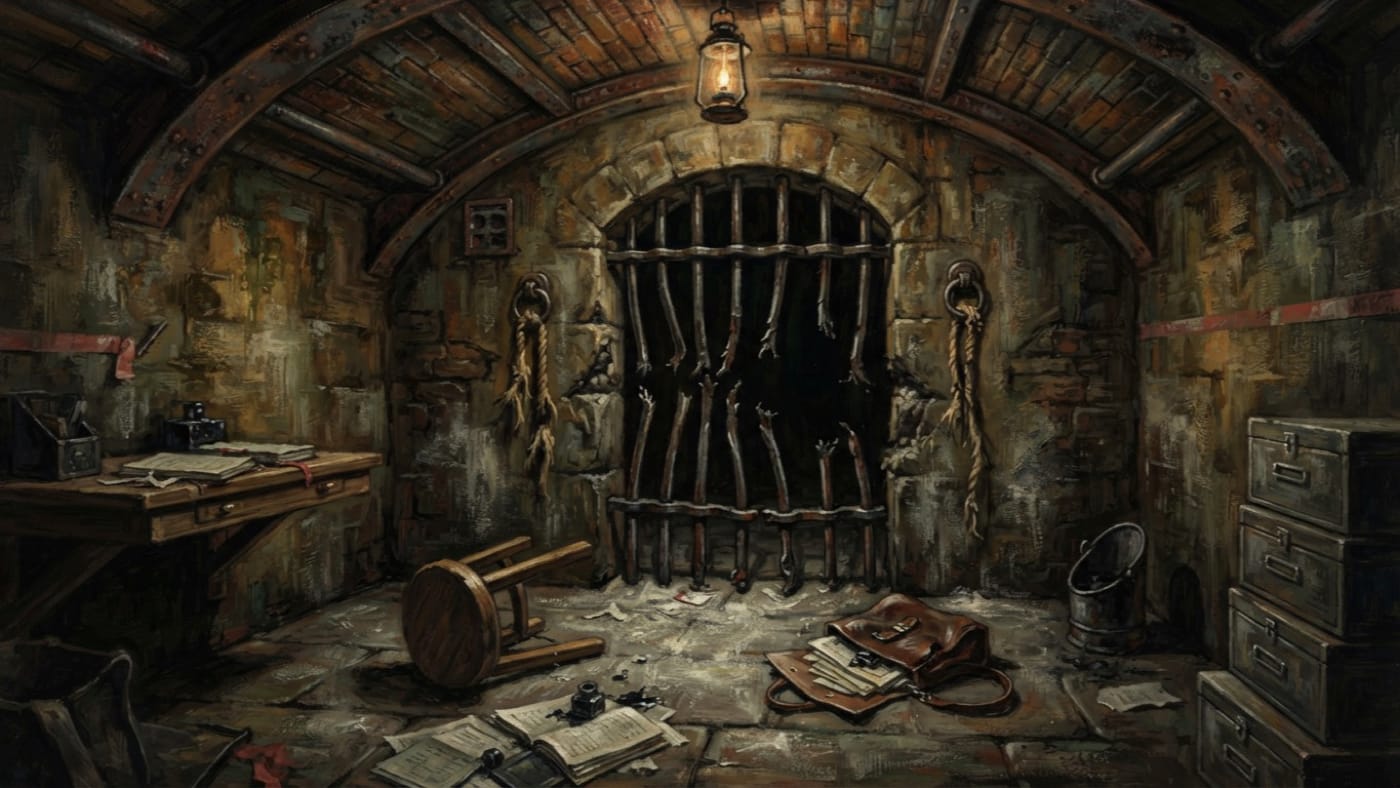
The Chalk Pantry incident of A.S. 190 (1900 CE) takes up three lines of the Bureau's contamination doctrine. Those three lines have outlived the manual whose advice they ended. The incident belongs to the fourth station of Kargath's mortal cult, the Consumed. Its fame rests on one administrative consequence: a regional manual had advised that Consumed-tier subjects be captured for extended theological interview, and after Chalk Pantry it stopped saying so. The Hierarchy of Need was sealed eleven years later. It records the revocation as an erratum and gives the cause in a single sentence: the subject consumed the interview grille, two confession ropes, and enough of the attending notary to leave the transcript grammatically unstable.
That sentence is the whole of the evidence. I have built on it only what it will bear.
Readers who want a raid at dawn, a door kicked off its hinges and a sergeant with a lantern and a bad feeling may buy the penny pamphlets. The pamphlets have never let a missing fact spoil a cover illustration. The doctrine names no city, no householder and no officer. It gives a pantry, a year, three kinds of loss and a correction. That is more than most institutional disasters get. Most are remembered only as a revised form number.
#On the Subject of Interview
The Consumed are what is left when provision has finished its work. Kargath's gifts are real, and so is the hunger that comes after them. The Hungry are fed. The Fed remember the feeding and recruit others. The Providers hand out the food and taste it themselves. Somewhere along that climb the appetite grows larger than the bread. Bureau of Medicine assays of seized grain have confirmed that the produce of the Harvest and the Abundance Fields gives honest nourishment. The cruelty lies in what that nourishment teaches the body to expect. Relief turns into dependence. Dependence turns into need. When the need outgrows any table, the person has become one of the Consumed.
The field definition is plain. The Consumed are too far gone for public cult work and more hunger than human. Providers keep them fed so they do not devour the rest of the congregation. They are kept behind locked doors in cellars, attics and back rooms. The doctrine does not say whether the Chalk Pantry subject was kept in that pantry by its Providers or only brought there. The incident carries the pantry's name, and I will not furnish the room.
The class has known marks: a widened jaw, sharpened teeth, a swollen belly that is still empty, and a restless chewing that goes on when nothing is in the mouth. Some of the Consumed move on toward the forms the Bestiary files as Maw-Born or Hollow-Walkers. The record lists none of these marks for the Chalk Pantry subject. They describe a station. This subject is described by a single act.
The subject was also a person: someone once hungry in the ordinary way, who was fed by someone and probably said thank you. Doctrine's grimmer vocabulary, with its talk of souls consumed and tiers past saving, belongs to an office that would rather not file a name. Kargath holds people through appetite, deep and terrible, and nobody has proved that it destroys the will. The Consumed beg, promise, weep and remember. The parent tract admits that some stay human enough to know what they are becoming, and suffer for it. A prisoner in that state is patient, witness and danger at once. The regional manual chose to treat that prisoner as a seminar.
#On the Interview Apparatus
Extended theological interview is a respectable instrument with a long pedigree in the Synod's chambers. It assumes that heresy is a set of propositions, that propositions can be drawn out by patient questioning, and that a person's errors, written down properly, can be filed, compared and condemned. For this it needs furniture. Like the confessional screen, a grille separates the person asking from the person answering. Confession ropes keep the subject where the inquiry wants them. A notary turns spoken words into a record.
Each of these objects stands for a rule about where one party ends and the other begins. The Chalk Pantry subject disputed every one of those rules with the mouth.
The record lists the losses: the grille, two confession ropes, part of the notary. It does not put them in order, and I will not invent one. The ropes may have gone first and freed the subject to reach the grille, or the grille may have gone first and opened the way to the clerk. A compiler who makes up a sequence for suspense is only a pamphleteer with a better seal.
The list itself says a good deal. Every item was in that room to serve the interview. The grille protected the inquiry. The ropes held the subject for its use. The notary kept it for the Ledger. Item by item, the manual furnished a room for a conversation with things that could be eaten. The subject made no distinction between a grille set aside for doctrine and a bone set out for supper. Only the manual's author made that distinction, and the author was not in the room.
Then there is the notary. The doctrine measures what happened to a human being by its effect on the paperwork: "sufficient portions … to render the transcript grammatically unstable." In that sentence the notary comes last among the equipment, and the transcript is the first thing anyone worries about. I will not improve that sentence by guessing at what it leaves out, and I do not know the notary's name or what became of them afterward. I only point out its grammar. The Bureau that wrote it would see no reason to.
The tract quotes no part of the unstable transcript, and I will not write a fragment for it. Whatever the interview was meant to establish about the subject's theology, the subject's appetite settled first.
#On the Withdrawn Recommendation
A regional manual advises capture of Consumed-tier subjects for extended theological interview.
Revoked after the Chalk Pantry incident of A.S. 190. Capture remains permissible only when the subject is already restrained, sedated, jaw-braced, and separated from all furniture not made of stone. The revised clause says nothing about interview. The doctrine that records the revocation gives no date for it, and this erratum assigns none. The manual's author is not named. The manual's advice no longer stands.
The revised permission is four conditions joined by a single adverb, and the adverb carries the weight. The old manual treated capture as the start of the interview: take the subject, then question them. The new clause treats capture as the end of a procedure someone else has already performed. The subject must already be restrained, sedated and braced before the capturing hand is permitted to close. Capture remains allowed. What the Chalk Pantry incident ended was the habit of capturing first and planning afterward.
The conditions are cumulative, and each answers a part of the old furniture.
Restrained. The ropes were edible, so restraint becomes the first of four requirements and no longer the whole of the arrangement. Sedated. This condition answers the appetite rather than the limbs, and it moves the stubborn sedative counsel of the Bureau of Mercy from the margin of field doctrine into its clauses. Jaw-braced. Only this condition is aimed at the mouth, the organ that ended the interview. Separated from all furniture not made of stone. This last clause admits more than the rest put together: the drafters stopped trusting the room. Wood, rope and iron fittings, along with any chair a clerk might sit on, were all reclassified as possible nourishment. Stone was the one material whose indigestibility the drafters were prepared to certify.
The tract gives the general positions of the three Bureaus on the Consumed in one dry line. The Bureau of War recommends fire. Mercy recommends sedation before fire. The Bureau of Purity recommends questioning before fire. No joint hearing is recorded, and I will not invent signatories. Still, the revised clause reads like a settlement among those three instincts. It keeps the capture that questioning needs, adopts Mercy's sedative as a precondition, and leaves War's fire where it has always been, waiting at the end of every sentence. Purity keeps its prisoner but no longer has the interview it wanted that prisoner for.
#On the Remaining Permission
The Chalk Pantry incident survives in the Codex as a citation. Its whole legacy is one struck recommendation and one narrowed permission, and both are still in force in the doctrine sealed by the Bureau of Doctrine in A.S. 201. Its warning is narrow and exact. An appetite that has outgrown bread will not stop at the furniture of inquiry.
The incident also comes at the end of an argument made earlier in that same tract, which committees keep returning to me as politically unsuitable. The Consumed are what the Synod pays for failures at earlier stations. Every Consumed prisoner was once one of the Hungry, and the Hungry can be fed lawfully, on time, with plain bread, before any Provider reaches the door. By the time a subject needs a jaw-brace and a stone room, the cheap remedy is years out of date. Feeding the Hungry first is the counsel the tract gives for the first station. Nobody has shown it to be a cure at the fourth.
Sedation and the brace are containment. They keep the mouth shut and the notary in one piece. They do not reach the will, and Kargath's appetite has never been shown to destroy the will either. Whether a person in that state can still turn back is a question the doctrine leaves open. It is not settled by the Bureau's preference for an answer that saves it paperwork.
Kargath feeds people. At Chalk Pantry the Synod sent a grille, two ropes and a notary to ask one of them why.