
#On the Carrier as an Engine
The registers of the Three-Night Bombard record four Catacomb-Carrier engines lost in A.S. 177. A layman reads engine and pictures a boiler. The clerks of Bastion-Constantinople meant the whole animal: tread, hull, ossuary plate, gun casemate, choir deck, hymn apparatus, crew compartments, and the sealed housing below. In the Foundry Quarter's vocabulary, the engine is the entire crawling church. Whatever moves it is listed elsewhere, on a different form, under a different seal, in a hand that presses harder.
An auditor must learn this distinction first, and a procurement officer would like him to forget it. A Catacomb-Carrier is requisitioned, commissioned, shelled, repaired and mourned as one machine. Its motive housing moves through custody as a separate item. The men who sign for it sign nothing else that day.
The carriers serve the southern Line. They work in Thracian mud, on the Bosphorus approaches, and in the trench country that faces the batteries of Maldrake across the Thracian Plain. Breach work is their trade: they crawl forward under fire, drop the ramp and put shield-saints and artillery into the gap. The registry lists sixty tons. That number is the sum of a great many smaller arguments.
#On Plate, Bone, and the Bound Housing
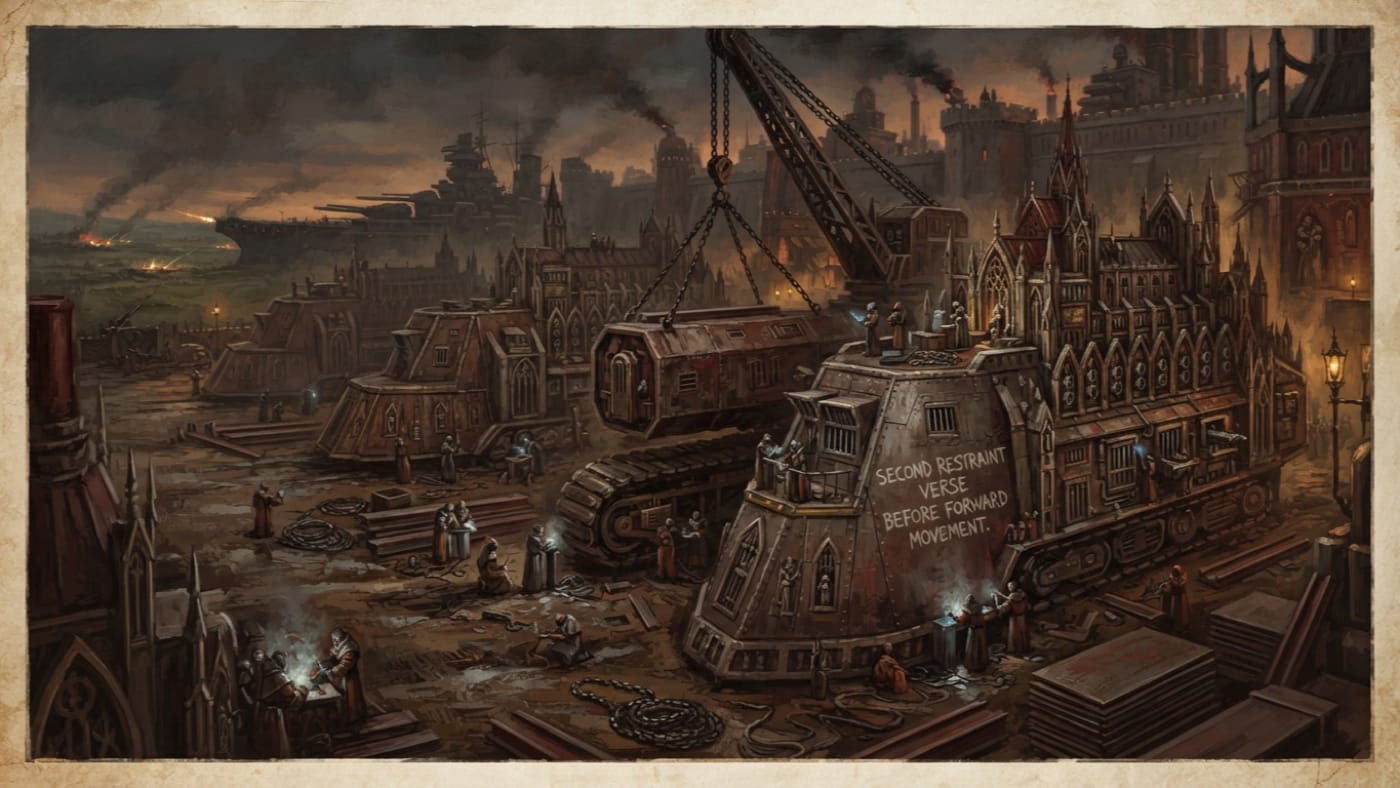
Carriers are assembled in the Carrier Yard, the southern waterfront strip of the Foundry Quarter. It lies between the Ossuary Rings and the Harbor of Chains, at the southern anchor of the Sagittal Line. The skeleton is made of bolted steel ribs. Over those ribs go layered iron, reliquary plate, ossuary brick and saint-bone mortar. Within the courses lie the remains of saints, martyrs and conscripts, recorded by the Yard with varying diligence. Saints receive a provenance. Martyrs receive a number. Conscripts receive the mortar.
The upper deck is a processional aisle, wide enough for a choir and the thuribles that follow it. The artillery sits beneath it in protected casemates. Midships, the shield-saints ride in sealed compartments. They are armoured reliquary frames holding authenticated martyr fragments, and crews in full panoply carry them forward during breach actions. They do not walk. Visitors who expect them to walk are disappointed, and then, once the ramp drops, grateful.
The motive housing sits lowest of all.
Five authorities handle a carrier before it crawls, and a sixth watches. The Bureau of War requisitions it and holds the charter. The Bureau of Engineering supplies drawings, measurements and tolerances, and it offers consultation in the voice of men who would rather be consulted from farther off. The Bureau of Relics supplies the bone and authenticates it. The Order of the Shackled Flame prepares the housing in the workshops beneath the Quarter. The Bureau of Doctrine governs what may be said of the result. Purity scrutinises and then yields to military necessity, which outranks it on every form that matters.
Procurement guidance in circulation attributed the Catacomb-Carrier programme to an Engineering design office in Strasbourg.
Corrected. The Codex has corrected this once already and will correct it again whenever the guidance turns up in some quartermaster's drawer. Engineering measures. War commands. Relics supplies. The Order binds. No single office owns the carrier, and that is exactly why every office can deny it.
The Order's charter permits the containment and motive application of residual demonic essences. Those are the charter's words. I reproduce them as institutional classification, the way one reproduces a tariff schedule, accurately and without endorsement. Public technical language prefers motive sanctification and anomalous drive cooperation. The charter declines to say what is contained, whether it knows itself, what it was before and what it wants, and I am not licensed to answer for it. The housing comes up the chain lift sealed and goes into the carrier sealed. Any cooperation that happens inside is reported only by its results, which arrive as sixty tons of registry mass moving forward through mud.
#On the Hymn and the Maintenance Rite
The bone-resonance hymn speakers run along each upper flank. Each is a saint-rib lattice set behind brass and voiced through prayer-vox ports. The older patterns on record carry twelve to a flank, and the A.S. 179 reconstruction pattern carries sixteen. I give these as documented patterns. The Yard has never produced two carriers it would swear were identical, and I have stopped asking it to.
The speakers carry licensed hymns across the trench line and steady the men who bear the shield-saints. They also keep movement and containment in step, which is the duty Engineering mentions last and the crews mention first. The operating rule is short enough for a brass plate. It was learned at a price no ledger page could hold.
Maintenance is liturgy with a spanner. Every bearing receives a saint's cipher before rotation. Every axle is lubricated under a ledgered rite. Bone-ash is packed into the brake housings and incense is flushed through the vents. The black oil is drawn off with the solemnity of a sacrament and the stink of a tannery. Calibration follows, then the seal checks, then the chaplain's signature and the foreman's. The Relics witness signs last, because Relics prefers to see what everyone else has risked first.
When a carrier fails, Doctrine blames the omitted rite and Engineering mutters about friction and heat. Both explanations are filed, and neither is ever withdrawn. The Litany-Engineers on the southern berths settled the quarrel in practice by doing both. They measure the clearance and sing the verse, in whichever order suits the master who is watching.
Crew service is punishment and honour at once. Postings come by tribunal or by petition, sometimes to the same man in the same year. Veterans testify that the hull laments when struck, that service grays the skin, that men begin chanting in their sleep and cannot be persuaded to stop. Some swear the machine consumes its crew by degrees. I record all of this as testimony. I have also stood on a carrier deck at dusk and heard the plates settle with a sound I would not describe to a tribunal.
#On Four Engines Lost and the Reconstruction Pattern
In A.S. 177, Velmora's agents bought their way into the Quarter's procurement and debt chains, and the Quarter detonated by instalment over three nights. The record of the carriers is brief and exact. Four engines lay in their barns with their ribs open, and their hymn-speakers pulsed without sound. By dawn after the third night, the Carrier Yard was a field of twisted treads and speakers.
The registers give no names for the four. They give no service records, no casualty count for any single engine and no note of which barn held which hull. I have looked. The column exists, and it is empty. An empty column in a War register is a sealed column whose seal has been politely left off.
Note the phrase ribs open. A closed carrier is a fortress. A carrier opened for work is a cathedral with one wall off: plate stacked on the floor, ossuary courses exposed, and the housing berth bare of the armour built to keep the world out and the contents in. Velmora did not need to know which barns held carriers. Greed needs only to know where the powder lies and who owes money near it.
While the Quarter burned, Maldrake's forward batteries opened on the northern ravelins. He exploited the fire. The record does not make him the one who bought it, and I decline to promote him.
Threnody survived. She was moored at Pier Seven under maintenance when the barns went up. That is the whole of her part in this section, and her service belongs to her own file.
Reconstruction was certified complete in A.S. 179 under four certifications: emergency production, structural safety in the Yard, doctrinal cleanliness of the Workshops and restored capacity. The reconstruction pattern carries sixteen speakers to a flank where its predecessors carried twelve. Its lifts and restraints are heavier. The Workshops below came back two levels deeper than the old plan, a detail the capacity certificate found too small to mention.
#On Present Application
As of A.S. 201, the carrier programme remains active under War charter, and hulls are still laid down in the Yard. Parts have been scarce since the Bombard, and trained crews are scarcer. A riveter can be made in a season. Training a man to sing the Second Restraint Verse steadily while something beneath the plating offers him a reply takes longer, and not every man finishes it.
Arch-Artificer Lute Brann has overseen the Quarter since A.S. 189, ten years after the rebuilding was certified. He inherited the reconstruction pattern. He did not draw it.
In A.S. 198, work on a motive housing ended in Incident 198-F/7. Fourteen artificers died, and scorch writing in the Triune Alphabet was left across the wall. These are not the fourteen trapped below in A.S. 177. Constantinople's dead keep falling into the same number, and the clerks have learned to annotate. Purity classified the event an industrial accident. The written name remains undisclosed, and I will not supply it.
Threnody remains moored at Pier Seven. Her maintenance has run long enough that the berth ledger and the harbour ledger disagree on its length. She is the Yard's comparison piece, an old-pattern carrier that missed the fire, and every reconstruction-pattern hull is measured against her. Her logs are consulted often and never read aloud.
The four lost engines keep their empty column. The barns have been rebuilt. On the new hulls, the Second Restraint Verse is chalked along the flank in letters twice the old height.
Filed.