
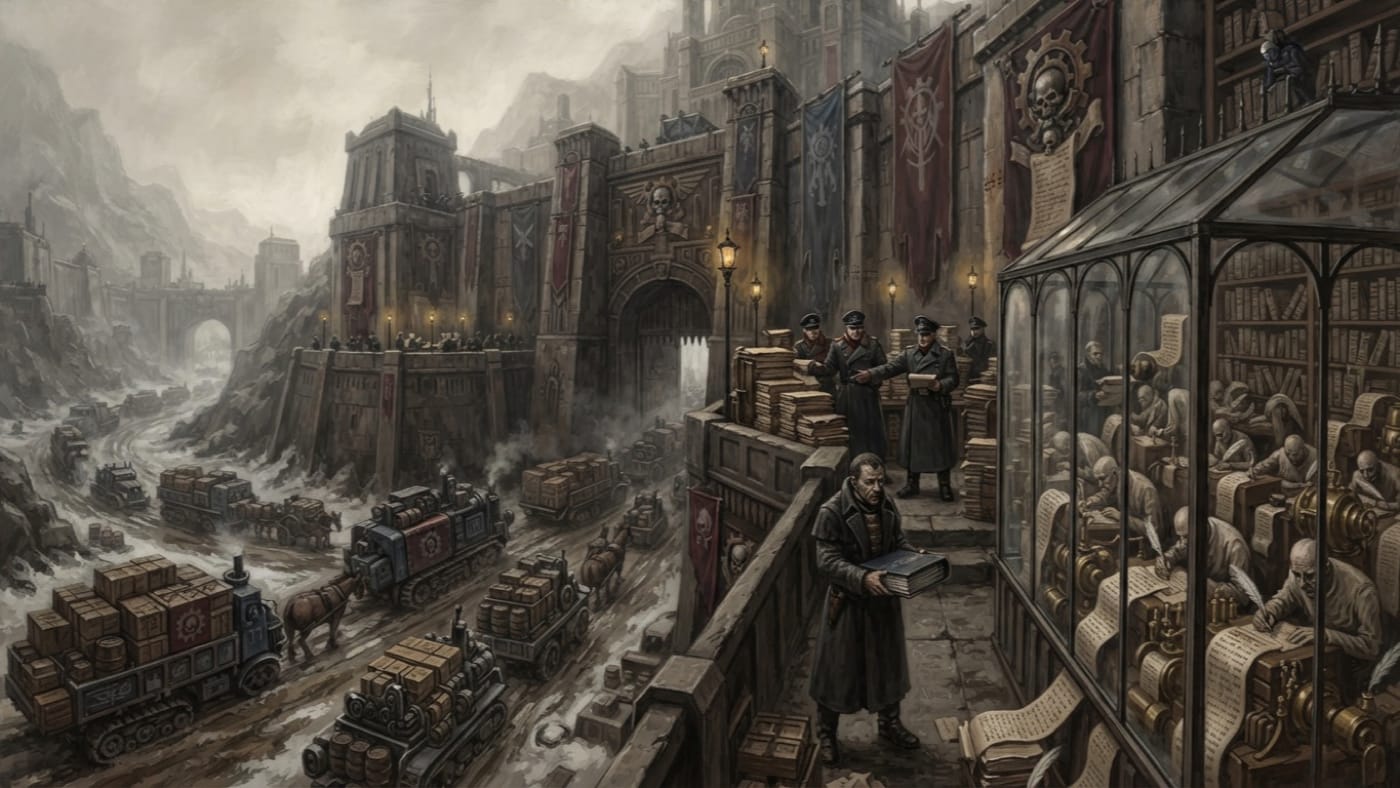
Caravan Houses
#On the House and Its Accounts
No charter defines a caravan house. No register counts them, no Synod office ratified the type, and no founding year exists for the class, because the class was never founded. It accumulated. The definition that follows is therefore mine, assembled from Court dockets, patron rolls and Archive deposits: a caravan house is a merchant concern that arranges caravan business across successive journeys and keeps what each journey leaves behind. Contracts. Claims. Debts. A convoy ends at the last toll bowl. A house carries the receipts into the next season, and the season after, and into the hands of whoever inherits the counting-room.
Some houses describe themselves in the language of family, and some of their liabilities have crossed generations. Neither fact proves that every house is a bloodline or that any house holds a road by birth. Commerce borrows the vocabulary of kinship because kinship is the cheapest collateral known to the Ledger.
The trade is necessary, which is why it can be bled. Grain, cloth, relics and coin travel the Church's roads beside pilgrims. At the Steppe Gate the freight is food, salt and war matériel, and the garrisons beyond the ridges eat on the strength of manifests. A house that stops moving does more than lose money. Somewhere a quartermaster counts sacks and finds the number short.
The Living Addenda entry records that three caravan houses have restructured debt obligations under amended clauses. The record gives no names and no sums. Three is the number in that account. It is no census of the trade.
#On Buying a Road
A house owns money. It rarely owns the road. Knowledge of the road belongs to the Caravan Factor, that licensed compromise between cartographer and smuggler who plans the route, reconciles cargo against weight, negotiates seals, times the gates and carries the purse for checkpoint courtesies. Factors serve merchants and convoy syndicate bosses. Many serve houses, and not all belong to one. The reliable cruelty is credit. A Factor who borrows to finance his bribe chain gives his route decisions to whoever lent the coin. The house supplies the purse. Within a season or two, the purse supplies the opinions.
At Windscript the purse thins fast. Before the stones will hear a caravan without offence, it must hold a stamped passage writ, a sealed escort contract, a certified dialect attestation, a countersigned goods manifest and a pronunciation certificate. Translator-scribes in the Scribe Bazaar sell the competence to speak a clause without closing one's own throat. Since the Red Pronunciation of A.S. 94 closed one thousand throats on a single damaged syllable, the Gate has treated speech as hazardous cargo and priced it so.
Then comes the waiting. Beasts held in the Caravan Corrals eat whether or not their papers move. Guards draw wages for standing in dung. Every day under red chalk is paid in fodder, lodging and hire, against a profit already promised to some western creditor.
Three officers stand between the house and the road. High Arbiter Senn Vark holds precedent and judgment in the Caravan Court. Seal-Mistress Ylena Korr holds certification through the Seal-House Consortium, whose impressions every writ, manifest, escort bond and Archive deposit must carry. Captain Rho Balesh holds the patrol chokepoints, and his riders decide when an escort may depart. The caravan lords are the compact's richest customers and its loudest challengers. They demand powers to rewrite the Treaty. Demand is the accurate word. Nothing in the file records a victory.
#On Purchased Precedent
A house that cannot own the law may buy a copy. Vark's precedent books are sold openly in the Scribe Bazaar, bound in goat-hide, stamped with nine weights, and indexed by clause, cargo class and fatality. Translator-scribes buy them. Caravan lords hoard them. A hoard of precedent is a peculiar treasure, since every volume binds its owner to Vark's reading the moment he cites it. The best-stocked library in the Bazaar is therefore also the most obedient.
The larger houses also keep counsel. Manifest Litigants under private patronage, the strain the Bureau calls Shadow Counsel, are documented among caravan-house clients. Their published methods require no blood. A disputed manifest strands a rival in a checkpoint town until fodder, guards and lodging eat his margin to the bone. A challenged route indulgence turns pilgrims toward a road that pays. A doubted convoy order makes a column miss its passage window and pay twice for the next one. These are recorded practices among patrons of the class. The record does not convict every house of them, and the Bureau declines to draft an indictment longer than the trade it describes.
#On Debts That Survive Their Makers
Ordinary road paper dies young. Factors burn spoiled manifests, throw away superseded chits, and lose tallies to rain so regularly that Tithes calls it weather. Paper deposited in the Burnless Archive beneath the eastern cutbank is another species. The Archive holds passage writs, toll assessments, escort contracts, rulings and confessions, and its retained originals neither burn nor leave. A clause that enters the vault continues to exist after the drover who spoke it, the Factor who sealed it and the patron who paid for it have all stopped existing.
The Gate's debt customs do the rest. Owed clauses compound. Default ends in labor conscription or in tongue service, the forced scribing by which a debtor repays the law in the medium that ruined him. I have found no statute decreeing that a grandson inherits his grandfather's toll. None is needed. The document survives, the house survives, and the claim finds the nearest solvent signature.
In A.S. 194 a Paper Keeper auditing the Fourth Vault found a folio that was missing from the master index. Its ink was wet. It amended a passage writ dated A.S. 118, reclassified a permitted route as compulsory, and imposed a toll on the seventy-six years that had passed since. For seventy-six years caravans had used that road lawfully. By evening, on the paper's reckoning, they had used it in arrears.
The Addenda carry genuine seals and valid witness fields, and no living hand is known to have written them. Vark settled their standing with a sentence I would have been proud to draft: if form is satisfied, the instrument binds. Ruling 201-Blue/17 confirmed it. A pulse is not a statutory requirement.
Caravan Court notices stated that living addenda were "under review and suspended pending decision."
Withdrawn under Ruling 201-Blue/17. Review suspends enforcement only when the reviewing authority outranks the instrument under review. The Caravan Court does not outrank the Treaty. Merchants who read the earlier notice as a reprieve were reading their own hopes into Court stationery.
For the houses, the finding is ruinous because it is orderly. A creditor can be bribed, outlived, sued, flattered or poisoned. An amendment without an author allows none of these remedies. There is no counterparty to petition and no hand to break. There is the clause, its wax, its witnesses, and an obligation older than the men now asked to meet it. The Living Addenda entry says three houses have restructured debts founded on clauses written before their grandfathers were conceived. The Archive's own entry speaks of three caravan lords revising toll arrangements under contracts signed before they were born. Neither account names a creditor, a figure or a settlement instrument. I decline to supply them. Invented precision is a forger's vice, and the Gully Market already has plenty of custom.
Compliance carries its own charges. Every amended obligation must be verified, sealed, filed and deposited, and every fresh Addendum needs fresh seal verification under Korr's nose. The houses pay to learn what they owe, then pay again to record that they owe it.
#On the Present Reckoning
In A.S. 199 the rubbing of the Third Stone's southern face disappeared, and every counting-room at the Gate grew nervous. A blank folio now lies where the rubbing lay. Its ink is wet, and Paper Keeper Seld inspects it each morning. That year the Keepers found between three and eleven new Addenda in each quarterly audit. In A.S. 200 one amended a Court ruling three weeks before the Court delivered it. By A.S. 201 they arrive about twice a week, and Korr's certification fees have tripled.
Seld's dossier records that Vark asked for his testimony in four sessions. Seld attended two, spoke six sentences, and cost three caravan houses a fortune. The record does not say whether these are the three houses of the Addenda account, or how the fortune was lost. Six sentences. I have known bishops who cost less per sermon.
The houses keep moving because the garrisons keep eating. They buy precedent, retain counsel, hire translator-scribes, pay for wax, and weigh alternative routes against the chance that Balesh's riders will notice. None of it has bought immunity. The rewrite powers are still a demand, and the Court is still the Court. The Triune Alphabet mandated in A.S. 178 now governs the clauses the houses must read, and the stones raised in A.S. 76 have outlasted every merchant who first paid to pass them. Doctrine's account holds that each enforcement inside the Ring feeds the treaty that binds the next caravan. Doctrine has not told the houses what to do with this information. Doctrine rarely does.