
#On the Ignition Requirement
The Canticle Primer is what a Catacomb-Carrier must hear before it is permitted to move. The Carrier Yard states the rule in six words of iron: no engine ignition without Canticle Primer. Licensed throats sing the Primer inside the hull before the lower housing is fired, before the treads take their first grudging inch of slack, and before any officer with a brass whistle starts believing he commands the thing.
That is the documented use. I record it first because it is the one point on which every source agrees, and in the Foundry Quarter agreement among sources is rarer than an artificer with ten fingers.
The reader will want more. They will want a composer and a founding night, a saint weeping into a hymnal by candlelight while a forge-master takes dictation. The record supplies none of it. It does not say who wrote the Primer, which office first licensed it, whether it is one canticle or a sequence, or whether it survives on paper or only in the scarred mouths of carrier crews. It says the engine does not wake without it. The Church has endured two centuries of the Great Deceiver's attention, and in that time it has learned to prize an instruction that works over a legend that flatters.
#On the Throat of the Engine
The layman pictures a gun-carriage with a chapel bolted on top. Until that picture is abandoned, no one will understand why a sixty-ton war-engine needs a song before it will accept fuel. The carrier is assembled in Bastion-Constantinople from iron, reliquary plate, ossuary brick and saint fragments authenticated under Relics seal. Its choir spaces are part of its body. Its bone-resonance speakers line the upper flanks, each a lattice of saint-ribs set behind brass teeth. Beneath all of it lies the motive housing. That housing is supplied and governed by the Order of the Shackled Flame, whose charter permits the binding of residual demonic essences into military casings.
Licensed singing travels through this anatomy under hymn pressure. It runs down the processional aisle, through the speaker ribs and against the casing, then out across the trench. The parent record states the purpose without ornament: the singing keeps the engine obedient and the crew stable. Coal, oil and gear discipline do their honest share of the work. The Primer opens the share no gauge records.
The record does not establish what the singing does inside the casing: at what interval, under what pressure, or against which particular appetite. I will not supply numbers so that a clerk can sleep.
An earlier technical digest, already corrected in the Threnody dossier, described the carrier as "a conventional armoured carrier fitted with devotional apparatus."
The correction stands and is extended here. Hymn apparatus is no accessory to a carrier. The singing that passes through it is no accessory to the apparatus. Any reader who filed the Primer under Fittings, Liturgical on the strength of that digest will refile it and initial the change.
#On the Carrier Yard Rules
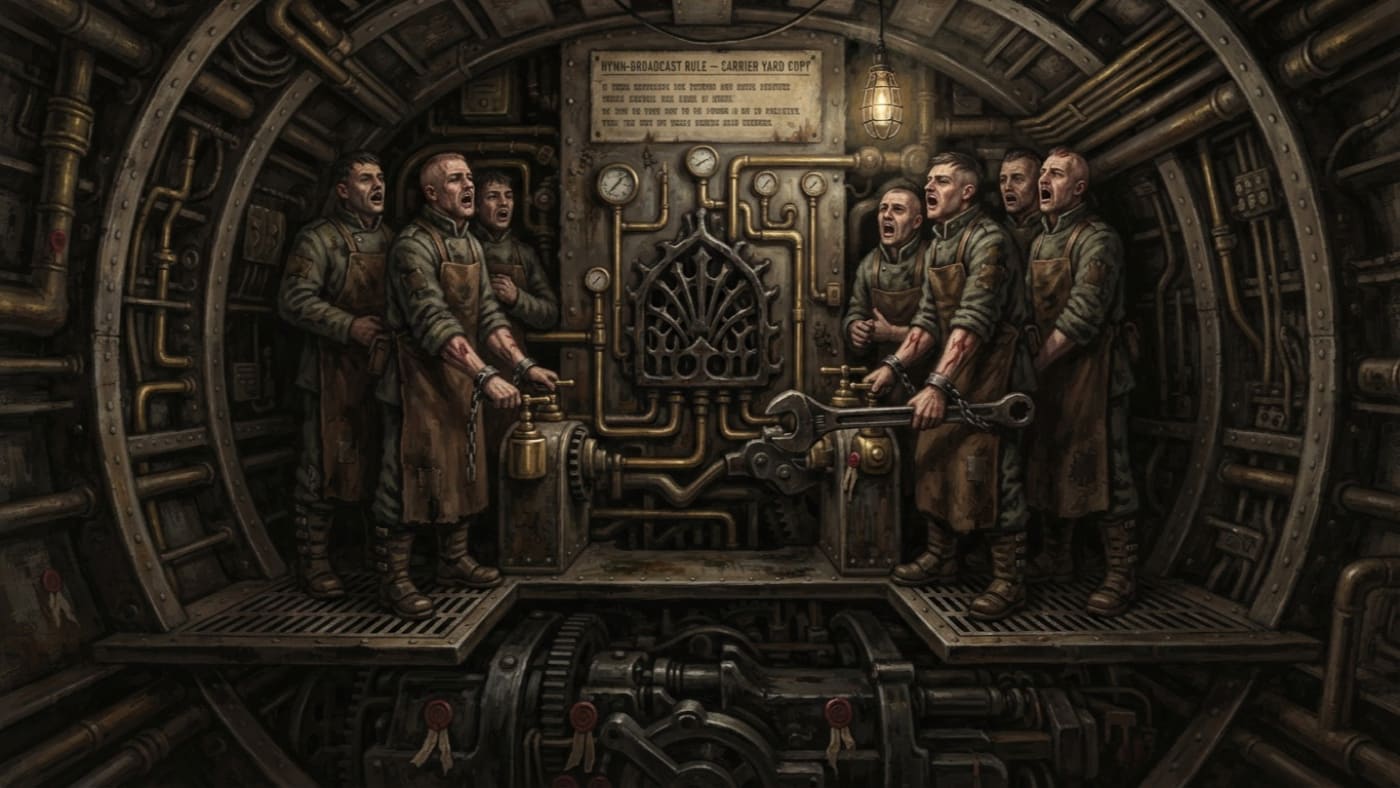
The Carrier Yard copy hangs as follows. I reproduce it without improvement, and the reader may count my restraint as a sacrifice.
There are four rules, and each is a separate obligation. A careless reader merges them into one long prayer. That reader has never stood in the Lung while the deck plates warm.
The first rule governs waking. The second governs motion, and it names a different text, the Second Restraint Verse. The rule does not say whether that Verse is a stanza of the Primer, a sequel to it, or a separate composition kept by other hands, and I decline to say it on the rule's behalf. Two names on one notice may describe one book or two. A Bureau that wanted them confused would have printed one line.
The third rule makes the Primer a beginning and nothing more. Ignition buys a running engine. It does not buy quiet. Once the housing is active, sound must continue, and whatever the crew sings next takes over the Primer's labour.
The fourth rule is the one now written in red. It was black in the A.S. 145 manual. Observe that it forbids answering. It does not forbid hearing. The Yard is realistic about ears.
#On Those Who Must Sing
Carrier crews serve under punishment-honour discipline. A man is posted aboard as a reward for courage, as a sentence for disobedience, as a cure for cowardice, or through a clerical accident too large for anyone to correct. Drivers, tread men, gun crews and shield-saint bearers all serve aboard. The choir mechanics and chained choirmen carry the duty of keeping sound in the hull. They sing in heat, in oil fume and in powder smoke. They sing with their hands on valves, because a litany-engineer has never been allowed a voice without a wrench attached to it.
The trade writes its cost on the body: raw throats and burned forearms. Hearing goes dull under the speaker ribs, and a tremor stays in the hands long after the treads are still. Threnody's ration invoices list throat lozenges among her standing stores. It is the most candid liturgical commentary the Bureau of War has ever issued.
I omit whatever the record omits. That includes any examination that judges a man fit to sing the Primer, any penalty for faltering, and any rank that holds the right to begin. I have read tracts that invented such things because their authors lacked the courage to leave a blank. A blank is honest. It is also cheaper to print.
#On the Tapping Beneath Threnody
Threnody was commissioned in A.S. 145. She is credited with thirty-seven engagements, survived the Three-Night Bombard of A.S. 177, and still carries the older arrangement of twelve speakers to each flank. Her old crews learned to sleep between hymn pulses and to count shifts by the condensation on reliquary glass. They learned one more thing, and it survives in their practice rather than in any manual.
They ignored the tapping beneath the lower deck unless it matched the Canticle Primer.
If the tapping matched the Primer, they sang louder.
That is the whole of the evidence, and I will not inflate it. The record does not say who tapped, or what. It does not say whether the cadence was learned, mimicked, remembered or a matter of chance. It does not say how often it happened, or whether anyone ever disputed a match. It preserves a single crew response, handed down as practice, and the practice is what concerns a man of my office.
Consider how little it asks of the crew. A sixty-ton engine knocks all the time. Rivets complain, plates cool, and the lower housing ticks like a sacristy clock. A crew that answered every sound would never sleep. So the old hands kept a single exception, and the exception was the Primer itself. The canticle that begins the engine's obedience was the one rhythm they would not allow to rise from below unopposed.
So far as any surviving folio shows, they did not halt the engine or summon an officer. They did not answer, because the red rule forbade it. They raised their voices until the hull carried nothing but their own singing.
Threnody now lies at Pier Seven of the Harbor of Chains under continuous maintenance. Her lower housing is not opened. Her crew is listed as intact, and the supplemental is not filed. No folio says whether anyone aboard still sings the Primer. None says whether anything beneath still keeps its time. The harbor log has one word for every such question, and the word is wind.
#On Present Application
As of A.S. 201 the carrier programme remains active. The Bureau of War holds the charter. The Bureau of Engineering supplies the drawings and the Shackled Flame supplies the housing. Doctrine supplies the blessing and the paragraph that explains it to the public. Every active carrier leaves the Carrier Yard under the same rule. The A.S. 179 reconstruction pattern raised the speakers to sixteen on each flank. The record shows no new Primer composed to fill them, and I add none.
The hulls are new and the plate is thicker. The housing is sealed with better wax under a more confident signature. The throats are new as well, and they are trained on the same requirement. Before the engine wakes, men sing to it. Nobody has yet filed a satisfactory account of what listens.