
#On the Reference
"A seal is also a sentence."
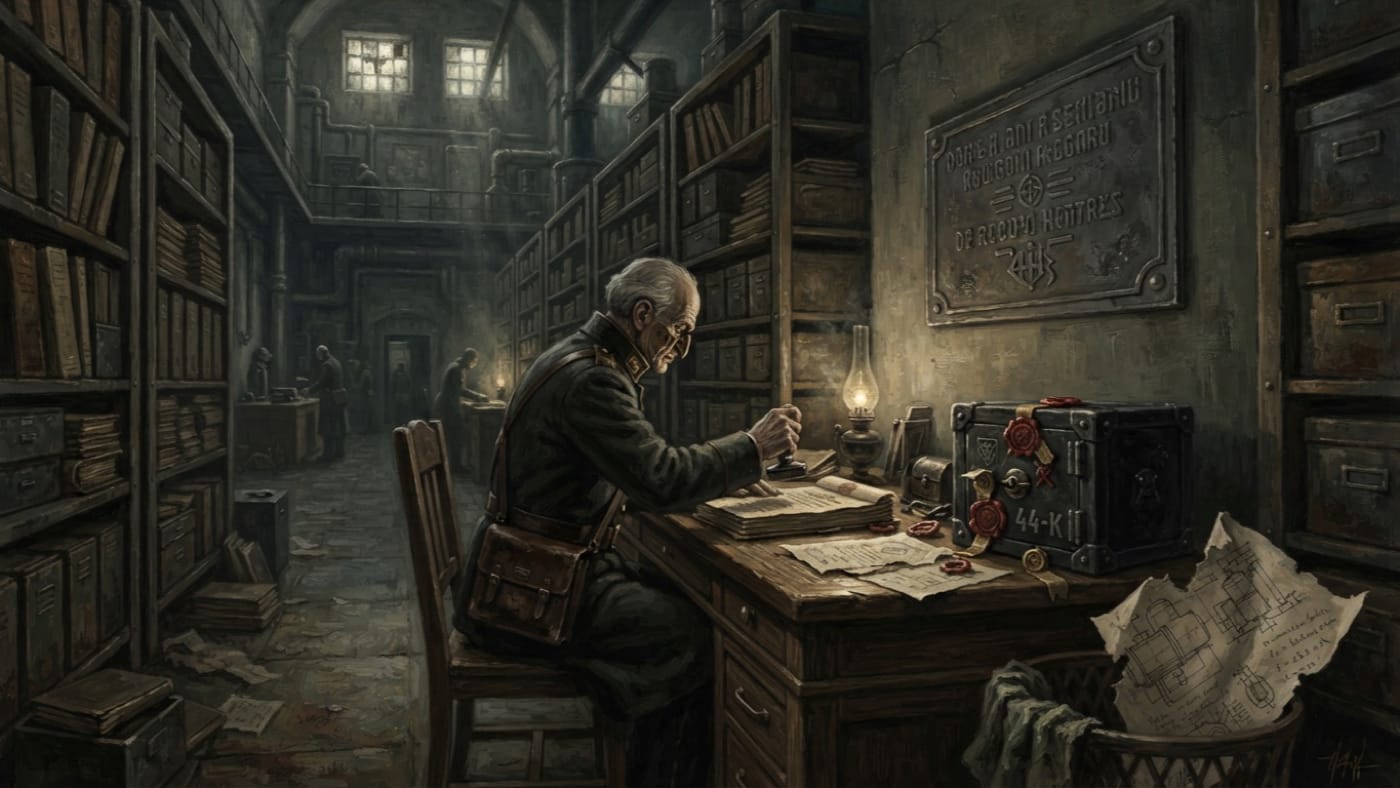
Bureau of Shadows File 44-K appears in the public record I am permitted to quote in a single clause of a single correction. In A.S. 147 (1857 CE) the Bureau of Doctrine amended its account of the Causality Purge. It conceded three things. The clandestine fuel manuals of A.S. 134 had an author. The author was a senior draughtsman of the Bureau of Engineering. And, in Doctrine's words, "his identity remains sealed under Bureau of Shadows File 44-K."
The correction tells us what he was. It does not tell us who he was. A corrected account and an unsealed identity are two separate instruments, filed in two separate cabinets. A reader who confuses them will waste a winter of candles requesting a folio that no clerk will fetch.
Consider also the grammar of the citation. The Bureau of Shadows officially does not exist. Doctrine, which has said as much in other correspondence, nonetheless printed a numbered file of that non-existent organ in a public erratum, complete with the hyphen and the letter. I have read the sentence perhaps forty times in the course of my duties, and it has not improved with any of them.
#On the Charge
The offence was paper. In a single winter of A.S. 134 (1844 CE), manuals known collectively as Fuel Is Chemistry passed through six bastion powerhouses. They explained combustion as mechanism and supplied diagrams. The copy recovered from the boiler pit at Bastion-Przemyśl, the Carpathian fortress the garrison calls the Wire Orchard, contained a conversion table. With it a stoker could calculate his own fuel load without consulting the approved catechism tables.
Mark the table. Of everything in the manuals, it is the article I would have burned first. A diagram can be preached against and an explanation can be answered with a better-sung explanation, but a table cannot be argued with. It works the same in a believer's hands as in a scoffer's, and it works at four in the morning when the Catechist is asleep. Engineering's arithmetic had left the Bureau that owned it and gone down into the pit, among men who shovel coal for a living. Those men had found it useful. To the Synod, useful knowledge in the wrong hands is the most dangerous kind there is.
Doctrine entered the manuals in the Index Damnatus as heretical texts. The Bureau of Purity dispatched its Lictors. At Bastion-Przemyśl alone, forty-seven stokers, eleven foremen and three shift engineers were immured: sixty-one souls at one installation. The account available to me does not name the other five powerhouses. I will not produce a total for the whole Purge by multiplying, as certain pamphleteers have, because the Ledger is not a slate for guesswork.
#On the Correction of A.S. 147
Here is the documentary centre of the matter, set out as the Ledger requires:
The Bureau's official record attributes the Causality Purge to "a spontaneous outbreak of Rationalist sentiment among uneducated labourers."
ERRATUM (Bureau of Doctrine, A.S. 147): The manuals were authored by a senior Bureau of Engineering draughtsman whose identity remains sealed under Bureau of Shadows File 44-K. The outbreak was literate, deliberate, and authored by a man with access to classified fuel-load specifications.
The struck formula deserves a moment's admiration before we bury it. "Spontaneous outbreak" puts the fault where Doctrine has always preferred to find it, at the bottom of the Chain of Cause among hands that have never held a pen. Heresy that rises from below needs no author, and it can be punished in quantity. The formula was tidy and liturgical, and it explained sixty-one immurements at one bastion without anyone in a clean collar being asked a single question.
The correction moved the source upward. It placed the heresy inside an authorised Bureau, at drafting-table seniority, in a man trusted with classified specifications. "Literate" and "deliberate" are hard words for Doctrine to print about a heresy. They describe a craftsman, and nobody had been looking for one.
Take careful measure of what the correction establishes. The author's occupation is released. So are his seniority, his Bureau and his access, along with the bare fact that a file holds his name. The correction says nothing about his name or his motive. It does not say whether Engineering knew of the manuals or sanctioned them, what sentence he received, or whether he outlived it. It does not even say why the file was sealed. A seal records a decision and keeps the reasons inside with the wax.
Thirteen years separate the immurements from the correction. I hold no record of what filled those years, and I decline to supply one. A great deal of bad history has been written by clerks who could not stand to leave an interval empty.
#On the Jurisdictions
The four Bureaus acted precisely within their charters, and the result is still an embarrassment.
Engineering owns the arithmetic: fuel loads, pressure tolerances, every specification that keeps a powerhouse from becoming a crater. Doctrine owns the why, which is the older jurisdiction and the one more jealously kept. Purity owns the consequence, and it collects in stone and mortar at the mouth of an immurement cell. Shadows, to whatever extent an organ that does not exist can own anything, holds the name. The Lore Book says it answers directly to the High Synod. I record that as said of it. I do not record it as sworn, because no one has ever produced a Custodian willing to lift his black gauze long enough to swear it.
The Causality Purge rested on the supposition that the danger climbs. The Furnace Catechist corps rests on the same supposition, and has since the Boiler Riots of A.S. 104. Stokers want explanations. Explanations are Engineering's property, so the Catechist stands between the two with doctrine cards and a loudhailer and keeps them apart. The whole apparatus guards the bottom of the ladder.
File 44-K records that the knowledge came down from above. Nothing was stolen from Engineering. It was carried out of the building by Engineering's own senior hand, drawn with Engineering's own instruments, and set out in a format any stoker could follow. Purity then walled up the readers.
I say this as a servant of the Church who has signed worse things. The correction is a public document, and it is plain that Doctrine profits by it in the furnace feud. Its erratum names Engineering as the source of the heresy and says nothing about Doctrine's own sixty-one. That is a reading of the text and nothing more. If anyone ever drew up orders to that effect, they have never crossed my desk. The text, for its part, is perfectly clear.
#On the Use of the Precedent
"Explaining is stealing."
The Catechist's daily instruments are older than File 44-K, but the file sharpens them. Standing Order 14-P forbids unauthorised explanation in the galleries. Technical primers are confiscated at shift-change. Incident reports are sealed in approved language. The Pragmatists of the corps allow an engineer to shout "pressure" during an emergency and then make sure the word never reaches the report. Every one of these practices is a way of controlling what gets written down.
Read with that in mind, the correction makes two distinct lessons available. The Purist can take from it what he has always believed: Engineering itself carries the contagion, and the drafting room needs a Catechist as badly as the pit does. The Pragmatist can take a narrower lesson about ink. A word spoken in an emergency dies with the emergency. A conversion table outlives its author, travels through six powerhouses in one winter, and ends up in the Index.
The dispute did not end with the correction. In A.S. 158 the Trench Sermon Mandate followed the harmonic sabotage at Bastion-Shipka and extended Catechist presence to every power installation along the Sagittal Line. In A.S. 187, at the Essen-of-Hymnsteel foundries, a Catechist taught an apprentice real thermodynamics. Purity found out. The plant was reassigned, the Catechist immured and the apprentice sent to the Paper Mines of Ulm.
Neither affair reopened File 44-K. No surviving record connects either one to the draughtsman or to his manuals. Several pamphleteers have tried to string the three together and present them as a single conspiracy. I return their pamphlets unread, stamped "insufficient provenance", and they are shortly afterwards unable to find a printer, which I regret more than I can say.
#On What Remains Sealed
The public record leaves the following unanswered: the file's contents, its extent and form, where it is held and who may consult it, which Custodians handled the matter, how the author was found (if he ever was), the author's name, his sentence, his survival and his reasons. I have no further evidence on any of these, and I do not deal in guesses.
What the record does establish is that the most precise heresy of the Causality Purge was drafted by a man of the Synod's own technical establishment. Purity punished the men who read it, and Doctrine corrected the account without releasing the writer's name. Every later citation of the Purge either points at that sealed name or leaves it out. Any account of the Purge that omits the file is repeating the struck formula, whether its author knows it or not.
The furnace still roars, and the draughtsman's name is still held.