
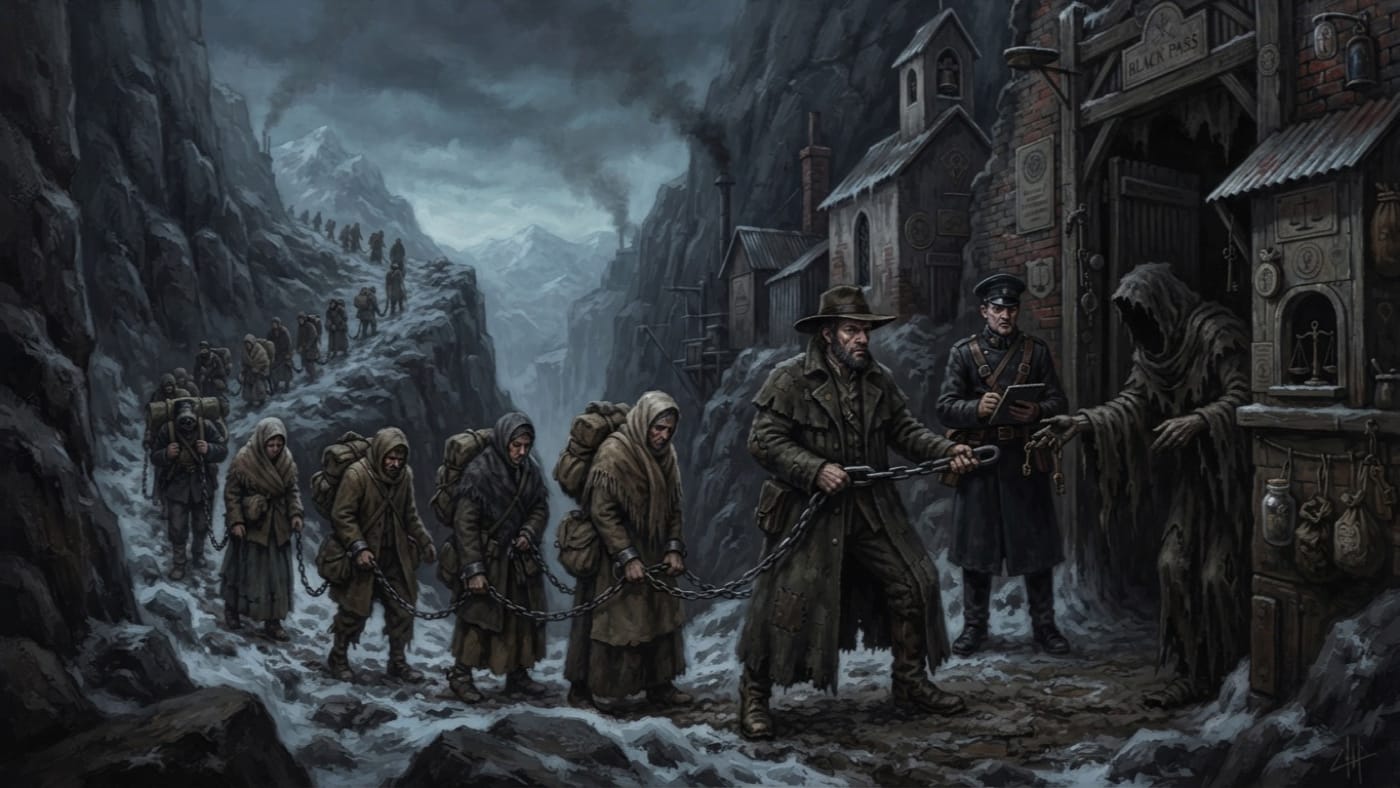
#On the Tenth Station
The Black Pass is the tenth Station of Obedience on the Varrican road. In devotional order it comes after the Ash Halt and before the Last Drag, two stops short of the Gate Blister on the Constantinople approach. That is all the Church can say about where it is without lying.
The order is liturgical. It counts blisters, and miles do not enter into it. The vita of Saint Varric of the Twelve Blisters gives the pass a name, a demon and a miracle. It gives no ridge, river, village, bastion or bearing. Pilgrims arrive at the Black Pass every Jubilee season because the Bureau of Pilgrimage keeps a Station under that name, and the Station has that name because the tenth blister had to split somewhere. Whether Varric ever stood on the ground now tolled in his memory is a separate question. It has been filed, and nobody has answered it.
This survey records the cult, its texts and its professional use as they stand in A.S. 201. It does not record a visit. I have not been, and I am not persuaded anyone else has been to the pass the vita describes.
#On the Road in the Vita
The vita sends Varric out of Avignon toward Constantinople at the head of six hundred condemned, in the years before the Sagittal Line was fortified. None of the condemned is named. The road is frost, scree, mud and ruined roadside shrines, broken by passes where demons are said to wear pilgrim faces. The six hundred belong to the legend and should be left there. No Bureau has produced a roll that would let a clerk check them against a grave, a court or a mother.
The chain has three origins, all still in circulation. Varric forged it, or an angel gave it to him, or he stole it from a prison yard and made the theft holy by his intention. Doctrine keeps all three. At most Stations the quarrel is decorative. At the Black Pass it matters more, because the miracle there depends entirely on who had the right to open the iron.
Devotional primers in circulation along the Stations describe Varric's act at the Black Pass as "the first closing of the pilgrim-chain upon the Jubilee."
Corrected. The iron pilgrim-chain entered Jubilee use in A.S. 109, after retention failures across three seasons, and the Pilgrim-Chain Handler was licensed as a profession in A.S. 112. Varric's chain is older in the legend and younger in the record. The primers will be withdrawn once current stock is sold. The vendors expect that to take for ever.
#On the Offered Release
In the approved vita a demon meets Varric at the Black Pass and offers to break the chain. Varric tightens it.
The text says nothing more about the demon. It has no name, rank, face or purpose beyond the offer. Doctrine has not assigned it to any Sin-General, and I will not do the assigning for them because the nearest map seems to invite it. The miracle needs only the offer and the answer, and the answer is a hand closing on iron.
This passage is recited at Handler commissioning, with ash on both wrists and the keys not yet kissed. The theological lesson is obedience under terror. Every Chain Keeper learns the professional lesson before a second column: when the road turns dangerous, shorten the slack.
What shortening does to the line is not recited. A chain run from wrist to wrist does not share its misery out evenly. Draw it short and the column moves as one beast. One stumble pulls down three. A fall at the head tears cuffs at the tail. Nobody may step aside to vomit, pray or die without bargaining with the wrists on either side. Long slack lets ankles survive scree and lets a man fall alone. It also lets him run. The Handler goes up and down the column with key-ring, tally slate and mercy gourd, and at every narrowing must decide which of these failures the ledger can absorb. Water goes to those who can keep pace. The count is taken by touching cuffs and pressing marks into wax, and a wrong number does more damage than a bad blister.
Varric tightened. The Black Pass therefore teaches custody and calls it survival, and the two keep separate books. A column can arrive at the Gate Blister complete in number and ruined in body. The commissioning formula has no line for the difference.
#On the Closed Chain
A second Black Pass exists, and the Church would prefer that it not be read.
A suppressed Avignon devotional copy tells the night differently. In this version the request comes from the line itself. The condemned beg to be loosed so they can fight or flee. Varric refuses. By morning some of them are gone, and the chain is still closed.
DEVOTIONAL VARIANT — SUPPRESSED AVIGNON COPY (EXTRACT) At the Black Pass the condemned begged Varric to loose them so they might fight or flee. He refused. By morning ███████ were missing, though the chain remained closed. Varric wrote no names. The copyist added: "The chain had learned to count without bodies." Classification: apocryphal; possession discouraged.
The copy gives no mechanism, and I will not supply one. Handler barracks have plenty of candidates: cuffs opened without a key, wrists slipped out of iron without leaving skin behind, a demon's work, a deserter's trick, a copyist's invention. Each has its partisans and none has a document. The Bureau of Doctrine classifies the variant as apocryphal and leaves its question open. That is the proper procedure for a question that cannot be answered without losing something.
What troubles the Handlers is simpler than theology. The approved miracle promises that a closed chain keeps the column. The variant reports a closed chain and a gap in the column. Any Handler who has counted cuffs at dawn and come up short knows which version the commissioning rite left out.
#On the Station's Accounts
The Bureau of Pilgrimage placed the Twelve Stations where pilgrims already passed, where toll collection could be supervised and where bell-windows could be enforced. Varric's footsteps were not consulted, having left no survey to consult. The cult openly admits that some Stations are geographically implausible, and the admission costs it nothing. The Black Pass is wherever the route needed its tenth halt.
Like its siblings, it carries the standard furniture of a Varrican Station: a chapel, a custody claim, a reliquary niche, a route stamp, a water price, an indulgence scale and its own toll. That toll is assessed separately from the Ash Halt behind it and the Last Drag ahead. The categories are local, route, remission, chain maintenance and bell attendance. The Bureau of Tithes reports the Stations solvent as a system. It has published no figure for the tenth Station alone, and I will not invent one to please the curious.
The Handlers curse every toll-house on the road and rely on what the tolls buy. These are water points, shade, route marks and confession packets, plus a district frightened enough of the column to keep rescue cells at a careful distance. A Station that slows the march also feeds it. Hypocrisy run by a Bureau keeps a ladle by the barrel.
Then there is the dirt. Soil sold as earth from the Black Pass circulates in the Varric relic trade alongside heel skin, sandal nails, chain flakes and ash from the First Opening. The Bureau of Relics authenticates no Varrican body fragment and only some of the chain fragments. The dirt has received no recognition at all. A few ounces of stamped iron prove nothing about the soil, still less about the demon, and nothing whatever about the morning in the Avignon copy. The dirt sells regardless. Pilgrims rub it into split heels, Handlers keep pinches of it in key-pouches, and vendors refill the jars from whatever ground lies nearest the vendor.
#On Its Present Use
As of A.S. 201, Varric remains approved for Handler invocation and for Station toll literature. The Black Pass is the most quoted of his twelve stops. Its usefulness has survived the fact that it cannot be located, cannot be dated and cannot be squared with its own apocrypha.
Candidates still recite the offer and the answer with ash drying on their wrists. They are not told about slack in measured links. The Chain Keepers teach that on the road, at the first narrowing, with a hand closed over the candidate's hand on the iron. The Handler inherits Varric's choice without Varric's privilege of being written up afterwards by men who were not present. When the column reaches its own black pass, which may be a ravine, a flooded ford or an ordinary bend where something stands at the edge of the road, the Handler tightens or loosens. Then comes the dawn count, in wax.
The Church calls that obedience and pays for its chapels with the proceeds.