
#On the Commission
This entry indexes a present-condition survey commissioned for A.S. 201 / 1911 CE. That is the year of the commission. Białystok's founding, charter and consecration are not recorded in any folio placed before me, and neither is the day it first heard a locomotive. I decline to manufacture those dates for readers who like their towns to come with birthdays.
Białystok is a place trains pass through on their way to being needed. It lies on the northern military spur out of Warsaw. At one end are the dispatch towers that release the freight. At the other is the frozen bastion that receives it, Bastion-Königsberg. The commission covers the junction, the winter patrols, the signals that frost splits open like cheap reliquaries, and the delays that follow. The town's churches, markets, magistrates and census lie outside the commission and outside my evidence. Both boundaries are kept.
#On the Northern Route
The Bureau of War likes to recite the northern supply chain from the far end. Hamburg lifts the cargo. Kanzleiburg sorts it. Warsaw sends it forward along the Northern Corridor's last and flattest stretch. Two principal spurs leave Warsaw's eastern yards. The eastern spur runs to Bastion-Brest, and it has its own exposure and its own griefs. The northern spur runs through Białystok toward Königsberg. Białystok is a station on the northern road. Warsaw's two arteries do not divide there, whatever certain clerks have drawn for their own convenience.
The freight is documented by class. There is grain and there is ammunition. There are replacement personnel, a few of them eager and most of them only recently informed. There are bell-clappers cast at Essen-of-Hymnsteel for the throats of the Northern Carillon. There is also sacred freight carried under the requirements of the Bureau of Relics. Those requirements call for armed escort and climate-controlled covering. In practice the freight gets one guard on a flatcar and canvas when it rains. The survey does not know how many wagons cross Białystok in a week, how many tons they carry, or how much warehouse floor waits beside its sidings. I will not let a margin pretend otherwise.
Every eastbound departure from Warsaw obeys the published Northern Route Table: clearance, blessing, axle witness, cargo seal, War priority notation. The Rail-Confessors perform the blessing on Warsaw's platforms. By the time a train reaches Białystok it has been blessed, witnessed, sealed and given its priority. Frost attended none of these ceremonies.
#On Winter Signals
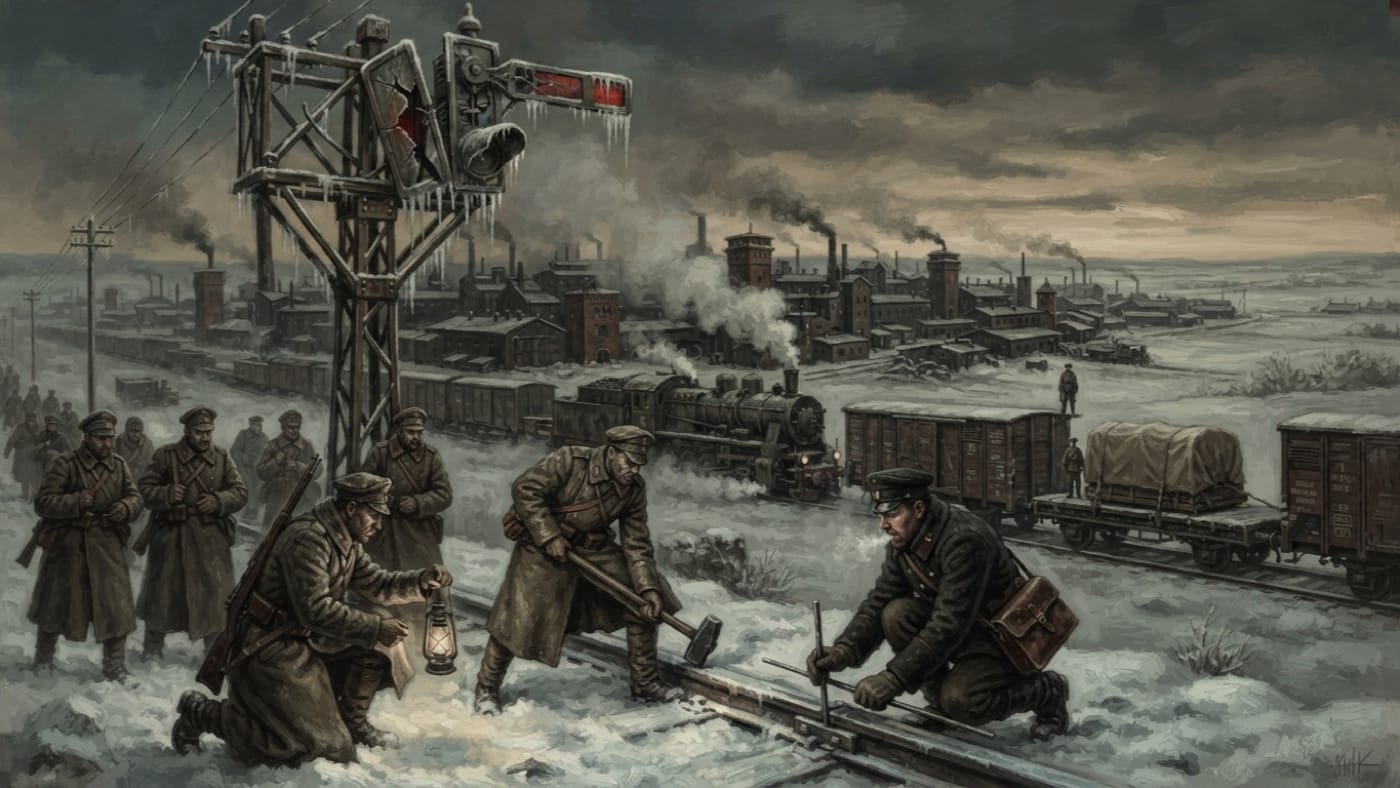
Cold attacks a railway in a fixed order of service, and the signal housings come first. Water gets into a signal box through a seam, a hinge or a badly puttied pane. Night freezes it, and the ice splits the housing the way a sworn witness splits a perjurer's story. A cracked housing lets in more water. The lamp gutters, the arm sticks, the bell-wire stiffens in its guide. The corridor's signal crews speak in lamp, flag, bell, telegraph and flare, and winter can silence any one of these while the other four strain to cover for it.
The rail comes next. Steel shrinks in hard frost. A flaw that summer tolerated opens along its length. The stretch north of Białystok has been recorded in corridor canon as the place where one ice-split rail can leave Königsberg waiting for bell-clappers while the Carillon rings with patched throats. I enter that as a vulnerability, the way a physician enters a weak valve. No dated derailment at Białystok has been put before this office. I will not invent a wreck to give the paragraph a corpse.
The cost of the cold falls northward. Königsberg's harbour freezes from December to March. For those months the overland route is no longer one supply method among several. It carries everything the bastion receives. The railway is most needed in exactly the season when it is least sound. No council has yet found a way to amend the calendar.
When a signal fails, the train stops. The stopped train waits for the dispatcher's word. The dispatcher waits for a maintenance crew to say whether the steel ahead will bear a loaded wagon. The crew kneels in the snow with a hammer and listens. Every one of these delays is honest. Every one is also counted at the far end, in days of grain and in the patience of a garrison that has never been famous for having any.
Delay invites a second reading. To an officer three stations back, a dark signal at the wrong hour on a front-line supply route looks like sabotage. Sometimes it is. Corridor canon records enemy agents, black-market crews, village grudges, and parents cutting wire to keep their sons off draft trains. More often the cause is water, frost and a hinge. A soldier who arrests the weather gets nothing out of it but a report.
#On Patrol and Repair
Rail security is the first charge of the Warsaw Standing Brigade. It covers the yards at Warsaw, squad patrols along the forward spurs, and support for the fortified signal stations on the Brest and Königsberg lines. In winter the northern spur toward Białystok gets extra men. The Brigade's own file gives the reason: frost cracks signal housings and makes every delay look like conspiracy. I can improve on neither its brevity nor its accuracy.
Three trades meet at a frozen signal, and each takes the other two for an obstruction. The soldier in grey-green guards the signal house and the track beside it, so that whatever happens there happens without a stranger's hand in it. The dispatcher authorises movement and answers for that authority, whether the train arrives or leaves its wagons in a ditch. The crew from the Guild of Rails answers for the steel.
The crew's methods are those of the track engineer wherever the Guild works. They lay the gauge rod across the rails and check the joints bolt by bolt. They fork the ballast and sound the sleepers. They bring the sledgehammer down on the rail-head so the ear can hear what the eye misses. Good rail rings. Cracked rail answers flat. Each finding goes into the maintenance ledger. On the northern spur it is the one document nobody can hurry, and the one that will be read closely after a wreck.
The pressure lands on the crew. War wants the train gone. The bastion wants it arrived. The ledger wants a true entry, and sometimes a true entry reads repair before passage. In February that means men lying on frozen ballast with bare fingers on metal cold enough to take the skin. Frostbite is a hazard of the trade. So is being crushed by a wagon that moves before the last man has stepped out from between the rails. Speed and safety both have advocates on the northern spur, but only safety's advocate signs the ledger.
#On the Railway's People
The corridor is inhabited, which the Bureau regards as an administrative inconvenience. Railway families live along it in signal hamlets: switchmen, lamp girls, axle inspectors, telegraph sisters, brake boys, and the women who keep the platform soup hot enough to disguise what is in it. Repair depots and night telegraph cabins stand beside the line. Refugees who never finished the walk west settle in the gaps. The survey records these as corridor conditions along the route toward Königsberg. It does not say which streets of Białystok, if any, they occupy, because it does not know. I do not dress up ignorance with street names.
Their work is what can be said of them. They hear trains before they see them. They know which wagons carry grain and which carry things no one asks about. In winter they are the first to notice a lamp gone dark, and the first to be questioned when it does.
#On Present Condition
Early Northern Logistics summaries described the Polish Corridor as "secure rearward access."
This correction was made for the corridor as a whole and is recorded in the Polish Corridor entry. The phrase failed the whole route, and it fails Białystok's stretch in the same measure. The northern spur is least secure in the months when the Baltic harbour is shut, which were the months the phrase was repeated most often.
As of A.S. 201 the northern spur through Białystok remains necessary and in use. On the route to Königsberg, winter failure of signals and rail is still an operational risk. It is met by extra Brigade patrols and by Guild crews whose ledgers keep filling. This office has no local figures for patrol strength, train frequency, repair interval or tonnage, and none appear here.