
#On a Name Inherited
"Every office claims a grandfather. The prudent ones choose a grandfather who left no papers." — the present surveyor, to a clerk who asked for the file
The Tribune-Chaplains name their ancestors in a single clause. Their own dossier lists the Ash Chaplains, the field confessors and the Orison instructors as their closest kin, and then, almost in passing, "the old battle-preachers from whom the office grew." That clause is the whole documentary estate. I have read it more carefully than the heirs ever did.
It proves descent as the office tells it, and it proves nothing more. The materials before this survey give no founding year and no founder. They give no charter, no training house, no habit, no roll of members, no seat and no burial of a last survivor. The capitals at the head of this page are the Codex extending its usual courtesy to a heading. The record does not say whether the old preachers ever called themselves anything so tidy, or whether they were only given the name later by officers who wanted a pedigree. I will not improve the record's manners for it.
What remains is a relationship. There was an older habit of preaching to soldiers in danger, and there is a later office of the Bureau of War that claims to have grown out of it. This survey concerns the relationship. The grandfather can keep his silence.
#On the Frightened Ear
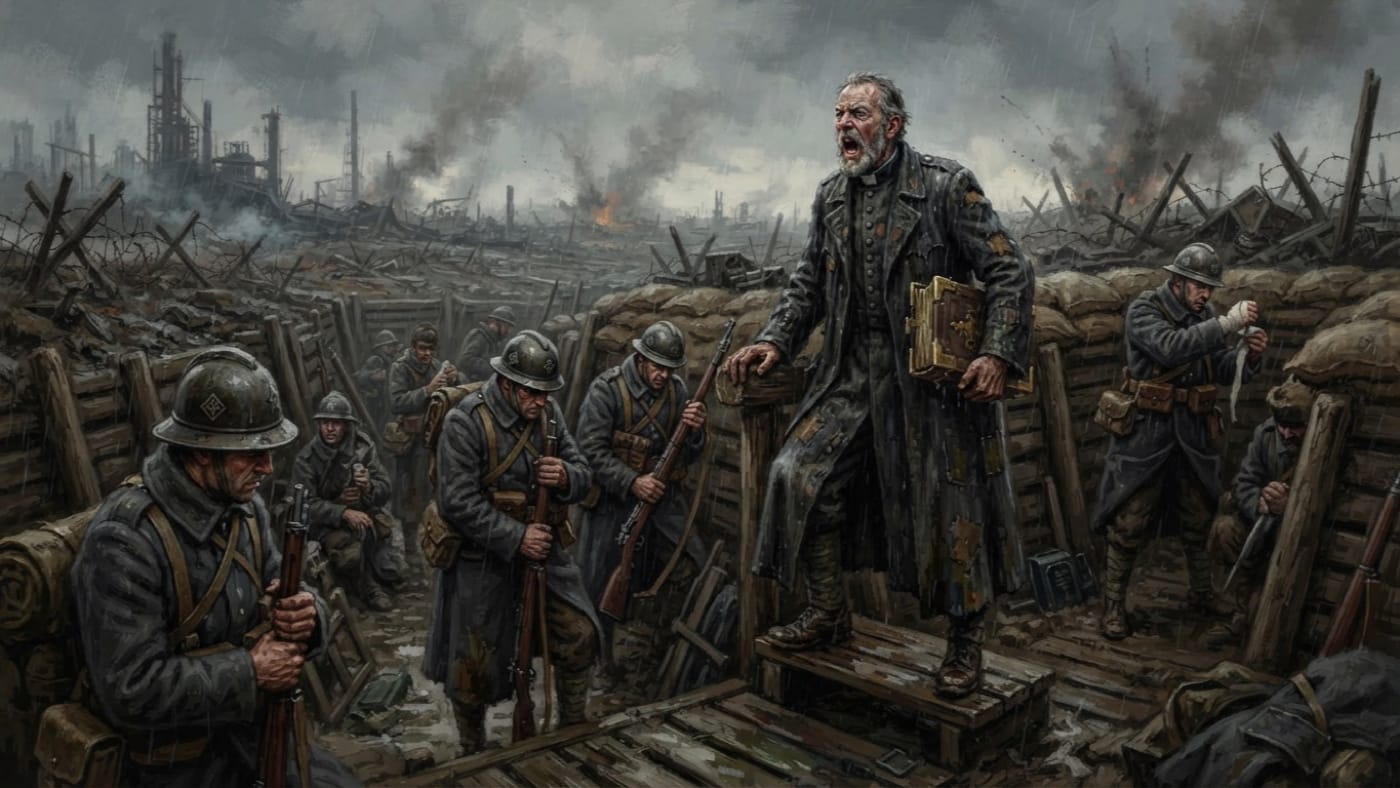
Fear narrows hearing before it narrows anything else. A man in a flooded trench hears the incoming whine, his own breath and the wet cough of the man beside him, and very little besides. An order shouted by a lieutenant reaches him as weather. A psalm he has known since his first catechism is different. It reaches him already half-sung in his own mouth, and he only has to finish it. Every army that survives its first rout learns some version of this. The Church simply learned it with better grammar.
The later office has put the lesson on paper. Tribune-Chaplains are trained to pitch a psalm so that the back rank hears the command inside the prayer. They learn which syllables carry through smoke, and they learn to fold doctrine small enough to fit between two volleys. Their assault prayers are short because rain on helmets is loud and grenades keep time better than cantors do. The Lore Book adds that War's officers write sermons in the middle of a siege, so that every barrage comes with its scripture.
From that lineage one thing can be deduced, and I mark it as a deduction. Whatever the old preachers were, they faced the same arithmetic of voice against noise, and of one frightened man against a frightened rank that answers together. They also had the one qualification no curriculum can issue, which is standing in the same mud. The Tribune-Chaplain's own maxim holds that the officer walks at the front because men are ashamed to lag behind a priest. The office claims that shame as part of its inheritance. I find the claim plausible. I cannot find it certified.
The cost belongs in the file as well. Voices crack by the second hour. The missal goes soft in the rain until its pages tear when turned. A verse is cut off in the middle of a line because the speaker has fallen over, and the congregation, having no one left to follow, finishes it anyway.
#On Speech Received as Obedience
In a cathedral the Amen is a response. In a trench, a response is compliance that has already happened. The congregation that answers the verse has moved once already, with the lungs if not yet with the legs, and a body that has obeyed once is well on its way to obeying twice. The Church has never pretended otherwise. It has only chosen gentler vocabulary for the nave.
War takes the process one stage further. It writes its after-action reports as if they were gospels. By the parent office's own admission, a Tribune-Chaplain's sermon serves as report, sedative, threat, legal shelter and scaffold for the account that follows. The Bureau of Doctrine values these men because they turn slaughter into meaning before anyone unauthorized can do it first. The chaplain's field note explains why three hundred men are absent from muster, and it does so without making a clerk write the word lost.
The office says it inherited the voice. The record says the office built the paperwork itself. Nothing surviving shows that the old preachers filed anything, testified to anyone, or answered to a bureau for the meaning of a casualty. Somewhere between the first preacher who shouted a psalm over a parapet and the first chaplain who made that psalm into a deposition, the Church found out that the man who speaks to soldiers under fire is also the first to write the battle down. Whether that discovery was quick, slow or never quite complete, no document I hold will say, and I refuse to give it successive reforms, a founding decree or an anniversary it never earned.
#On the Neighbours of the Pulpit
The Tribune-Chaplain's current place is well recorded. He stands beneath the Warden-General, beside the Vexillators and the Litany-Engineers, and holds his post under doctrinal certification. His neighbours in the martial liturgy do separate work. That work should stay separate on this page, because a tidy family tree is a herald's vice.
The Ash Chaplains carry relic-ash thuribles and lead the Litany of Stones, which keeps the Shield-Paladins and the engineers in step at a breach. The Processional Bands govern marching and firing cadence: drum to boot, pipe to volley, and horn to the moment the Radiant Fusiliers are called forward. Litany-Engineers calculate charges and maintain machinery while reciting sanctioned cant, and their verses are transmitted doctrine packed into powder. Nobody in the rear rank is meant to be moved by them. Vexillators command with cloth, making the formation visible where voices fail. Under the Doctrine of Layered Death, all of these are made to work together at the worst moment of a breach.
No source I have consulted says that any of these descend from the battle-preachers, that battle-preachers ever commanded them, or that the names could be swapped. They are neighbours. The Tribune-Chaplain alone claims the old preachers as ancestors, and the claim concerns one function only: a voice raised to command frightened men in the language of prayer.
That function is best seen in the successor. At Saint Hadrien's Ford, on the Night of the Three Bridges, A.S. 172 / 1882 CE, Tribune-Chaplain Sorellus began the Psalm of Iron while the Danube rose and the Vexillators went forward. He lost his lower jaw during the fourth verse, and the men sang on without him. Sorellus held the office. He was not a surviving battle-preacher and should not be filed as one. Still, a congregation that finishes a sermon after the preacher has been silenced is the oldest thing the office possesses. By the office's own account, it is exactly what the old preachers were for.
The Processional Bands chapter of the Lore Book places the Night of the Three Bridges on the Rhine, where every crossing was detonated at once and a band from Cologne played on as it drowned.
Corrected: the Three Bridges crossing recorded for Tribune-Chaplain Sorellus was on the Danube, at Saint Hadrien's Ford, A.S. 172. The Lore Book's own Bureau of War entry already said so, which proves that the Lore Book has occasionally agreed with itself.
#On the Survey of A.S. 201
For this survey's purposes, the tradition's place in the present office is settled. The Tribune-Chaplain curriculum now requires instruction in continuing under jaw injury, and it has added silent-command modules. The Bureau has written down, with forms, what earlier generations of field preachers presumably learned by bleeding. That too is a deduction. No regulation cites a battle-preacher as its source, and no battle-preacher left one to cite.
The survey assigns no stage of the Church's history to this tradition. The hidden Church before the Sundering of A.S. 45, the uneven public emergence that followed, the interim council of about A.S. 50 and the formal Synod of A.S. 90 are the Church's own divisions of its past. The old preachers have not been placed in any of them, and I will not place them there on a hunch. Levies raised long before the Continental Levy had its present form were certainly frightened, and presumably someone shouted scripture at them. That is as far as the file goes.
What the heirs gained from their ancestry is simple enough. A grandfather with no papers cannot contradict anything the family chooses to remember. The Tribune-Chaplains keep the old preachers the way a regimental chapel keeps a relic of disputed provenance. They kiss the case before crossings and do not open it.