
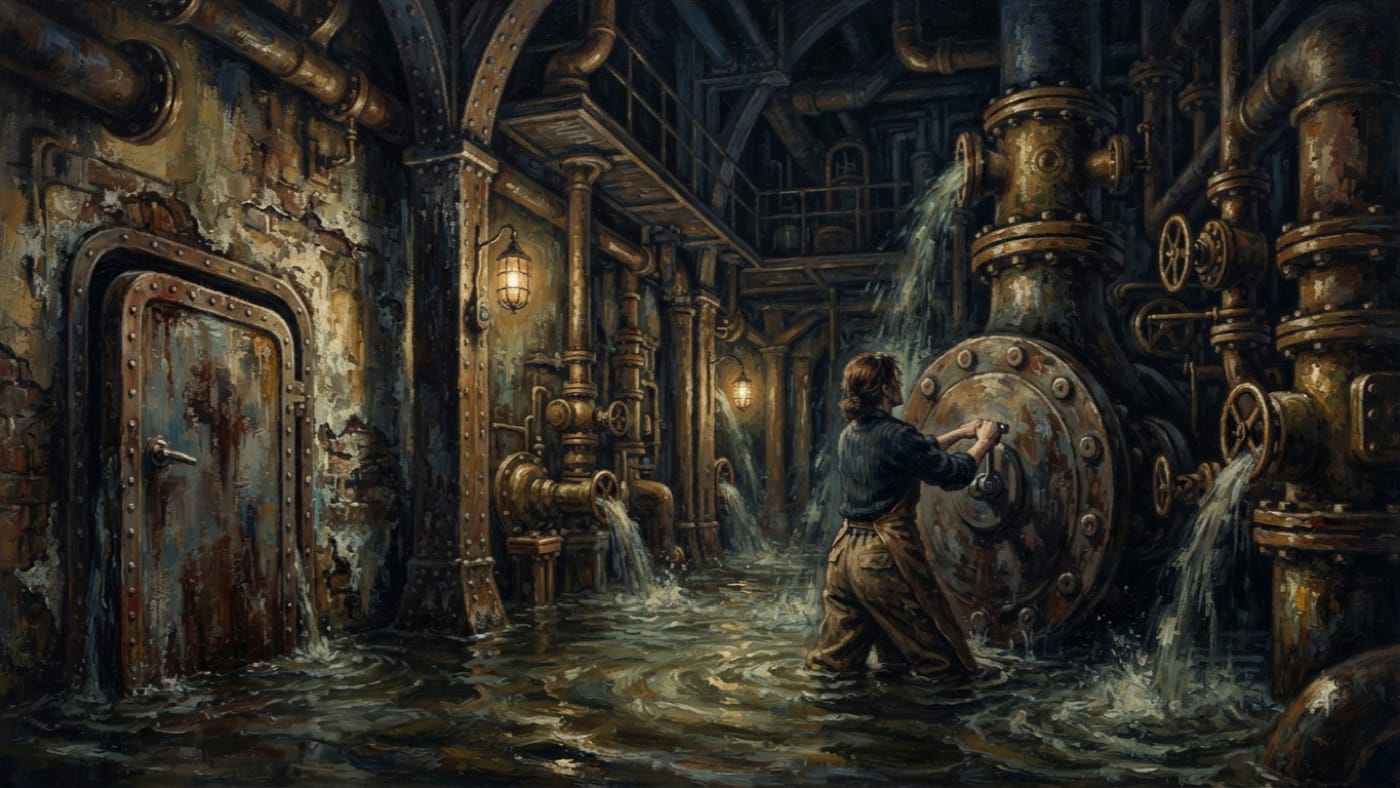
#On the Rear Bastion
Behind the Line, the water is the enemy that files no declaration.
Bastion-Metz was never one of the seven. The Sagittal Line keeps its seven great anchors far to the east, running north to south where the Enemy can inspect the masonry personally. Bastion-Metz stood well behind that frontier, a rear fortress and supply-bastion attached to Metz. Its work was to receive, store, pump and forward. Nothing that reached the Line from the Lorraine corridor reached it without first being counted, pressurised, blessed or delayed somewhere in the Metz works.
I have found no record of its founding that I am prepared to sign. The civic expansion of A.S. 98 regularised the city's warehouses and ash vaults. That was the city's business and cannot be lent to the fortress to serve as a birthday. The Bureau will forgive me an absent date sooner than an invented one. The Ledger will not forgive either.
What the files preserve about the bastion is plumbing, and plumbing has the advantage of being truthful. Pressure moved its gates. People slept in its wards. Maintenance kept the first from killing the second. Every other claim made for the old fortress is devotional reconstruction, and I mark it as such.
#On the Underworks and Seal Seven
By the time of the flood, Bastion-Metz had outgrown its walls in the way that rear fortresses do when refugees arrive faster than the Bureau can refuse them. The official Life of Saint Orla of the Seventh Line lists what had spread beyond the curtain: refugee wards, boiler sheds, rail locks, ash vaults, and the wet underworks that fed pressure to the gate machinery. The Life was written to glorify a saint. The inventory is the most useful thing in it.
The underworks were a tangle of conduit and service passage below the waterline of every sensible plan. Somewhere among them was the lower engine chapel, where mechanics kept the seals that held the pressure lines. One of those seals is named in the account as Seal Seven. It served an old pressure conduit rebuilt over pre-Synodal stone. The Life says it had been patched through three wars and blessed under four incompatible rites. Each rite presumably cancelled the others, and the mechanics went on tightening the bolts regardless.
Seal Seven fed the western pressure door, and the western pressure door kept dry a low ward of families, condemned labourers, and children whose parents had paid for dry bunks with three months of ration debt. That dependency is the whole character of the place. A rubber ring the width of a man's hand, seated across eight bolts on an old flange, stood between several hundred sleepers and the river. The Bureau of Engineering calls this a critical seal. The ward had no word for it, since the ward was asleep.
The procedure for such a seal is the one later codified for every Gasket-Hymn Mechanic: cleanse the flange, align the ring, seat it, and torque in star pattern to the cadence of the Boundary Litany, then chalk witness lines across the bolt-heads to prove nothing has shifted. At Metz the chalk marks survived their mechanic.
#On the Flood
The official Life is damaged, and the year of the flood is among the pieces the damp took. I date the incident to A.S. 132 / 1842 CE, on my own authority. The Bureau of Records may correct me once it has dried its files. No day, month or season survives. The account keeps time by the canonical hours instead: rain began at Matins, the water was a verdict by Vespers, and the dead were recovered after Prime.
The river entered through the ordinary weaknesses of a working fortress. According to the Life, it came through the culverts, then the sump doors, then the coal drains, then the confession runnels, and last down the southern service stair, which was the route the mechanics would have used to leave. The Life records that mechanics fled and mechanics died. Orla stayed at Seal Seven.
The seal had slipped and the old gasket had swollen. A replacement ring would seat only through the full sequence, which meant timed tightening across all eight bolts while the water climbed past the flange she was tightening. The explanations for what happened next are filed in parallel, Metz fashion. Engineering credits preparation, timing, torque and witness marks. The Bureau of Doctrine credits obedience. The workers say the pipe had to be addressed correctly, and that Orla addressed it correctly.
I certify none of the three over the others. Committees have been founded on less.
The earliest named witness is Wax-Hand Jerun Pell, twelve years old at the time. He later became a licensed Torque Technician and was later still immured for unregistered sequence alteration. The Bureau venerates his testimony and buried the man who gave it. Pell states that the pipe knocked once at the Sixth Line and that at the Seventh the water stopped climbing for a number of heartbeats the file has since redacted. He states that when they pulled the door afterward, her hand was still on Bolt Eight. All of this is testimony. It has not been established as mechanism, and I file it where it belongs.
What is established is less musical. The seal held. The western pressure door stayed shut. The low ward survived. Orla did not.
Chapbooks sold in the Metz markets hold that Saint Orla turned back the flood at Bastion-Metz by prayer alone.
Corrected against the Engineering addendum and the surviving tool marks. The flood was not turned back. A repair was completed under it, bolt by bolt, in sequence, while the water rose. The prayer was part of the procedure. The chapbooks have been advised. They continue to sell.
The rescue ledger for the low ward lists seven hundred and twelve names. Records later reduced this to six hundred and eighty-nine after excluding those rescued without proper bunk permits. Both figures count the living pulled from one ward. Neither is the fortress's population or a death toll, and anyone quoting them as such will receive a correction slip.
#On the Recognition That Followed
The Bureau of Doctrine canonised Orla in A.S. 162 / 1872 CE, thirty years after the date I assign to the flood. Thirty years is the time it takes Doctrine to decide that a drowned mechanic is safe to honour. Engineering, which dislikes incense, named a torque specification after her instead. Orla-Seven torque is used on critical seals under wet, cold or vibration-compromised conditions: three light passes, one listening pause, two opposing seats, and a final quarter-turn on the closing syllable. Mechanics trust the specification more than the hagiography, and they are right to.
The disaster that turned the craft into a profession happened elsewhere. The Split-Ring Disaster of A.S. 164 / 1874 CE, two years after the canonisation, struck the lower works of Bastion-Przemyśl. An abbreviated cleansing verse spread failure through seventeen engine pits. Licensing, Operational Classification 7-G and triplicate rite sheets all date from after Przemyśl. None of them reached back to Metz. Orla held no licence because none existed to hold, and no auditor has yet worked out how to fine a saint for undocumented heroism.
The chronology does its own work here. A flood in a rear fortress produced a saint, the saint produced a torque pattern, and a catastrophe at a distant bastion turned that pattern into law. Bastion-Metz supplied the example. Przemyśl supplied the corpses that made the example compulsory.
#On the Bastion in Professional Memory
A place remembered through a saint does not stay in its own hands. Seal Seven now belongs to two factions of mechanics, neither of which has ever stood in that water.
The Line-Purists read Bastion-Metz as proof that the sequence cannot be divided. Orla finished every word, so the seal held, and a mechanic who abbreviates is a mechanic who has chosen to drown someone else. The Field Pragmatists read the same flange differently. To them the listening pause is the lesson: a mechanic who understood the seal and judged the work under rising water, and who died because nobody relieved her. Both factions keep a painted Orla in their sheds. Neither can show that she would have joined them. Her opinions were not recorded, so both factions attribute their own to her.
The physical memory of Bastion-Metz is thinner and more disputed. The torque key claimed as Orla's is held in the Metz Ash Vault, under glass and under a custody schedule that every Bureau responsible for it has broken. The Bureau of Relics has authenticated it twice and questioned it once, and it declined a fourth inspection after the key was reported to have turned a fraction of an inch in its case during a novice examination. That movement is reported, and I record it as reported. The key's presence in the vault proves that the city kept a key. It does not prove the engine chapel still stands, that Seal Seven remains, or that anyone could now walk down the southern service stair.
#On What the Records Preserve
As of A.S. 201 / 1911 CE, the Codex can certify a few things. Metz still counts and forwards supplies for the Line. The Orla-Seven specification is taught in every licensed gasket shed from Przemyśl to Bastion-Irongate, where the craft is practised on machinery far louder and far less forgiving than the old Metz conduit. The rescue ledger survives in two sums. The key survives in the vault.
The condition of the fortress itself does not appear in any file I have been shown. I will not say it is ruined, and I will not say it is restored. I will not say whether its underworks still take water when the river rises. The Records clerks who might know are the same clerks who once lost the year of the flood.