
#On the Guard's Station
A wall is masonry. A Guard is a wall that answers when its name is called.
This survey was commissioned in A.S. 201 and covers only the unit as it stands in the present year. Its subject is the Bastion Guard, the line infantry of the Covenant, entered in the roll of Covenant Units with the single word Basic beside their name. Lesser clerks read that word as a slight. It is a classification, and a flattering one to anyone who understands arithmetic. The basic soldier is the integer from which every calculation of the Church's armies proceeds, the plain noun to which the Bureau of War afterwards attaches its adjectives. Elites are reckoned by the file. The line is reckoned by the mile.
Line infantry hold ground in ranks. That is the whole of the trade. It asks for presence, obedience and a reluctance to step backward, which the Church, in its kinder moods, calls constancy. I prize constancy above brilliance. Brilliance writes pamphlets and is eventually burned with them. Constancy stays in its file when the file is struck, and a soldier who stays in his file has grasped more doctrine than half the seminaries of Strasbourg.
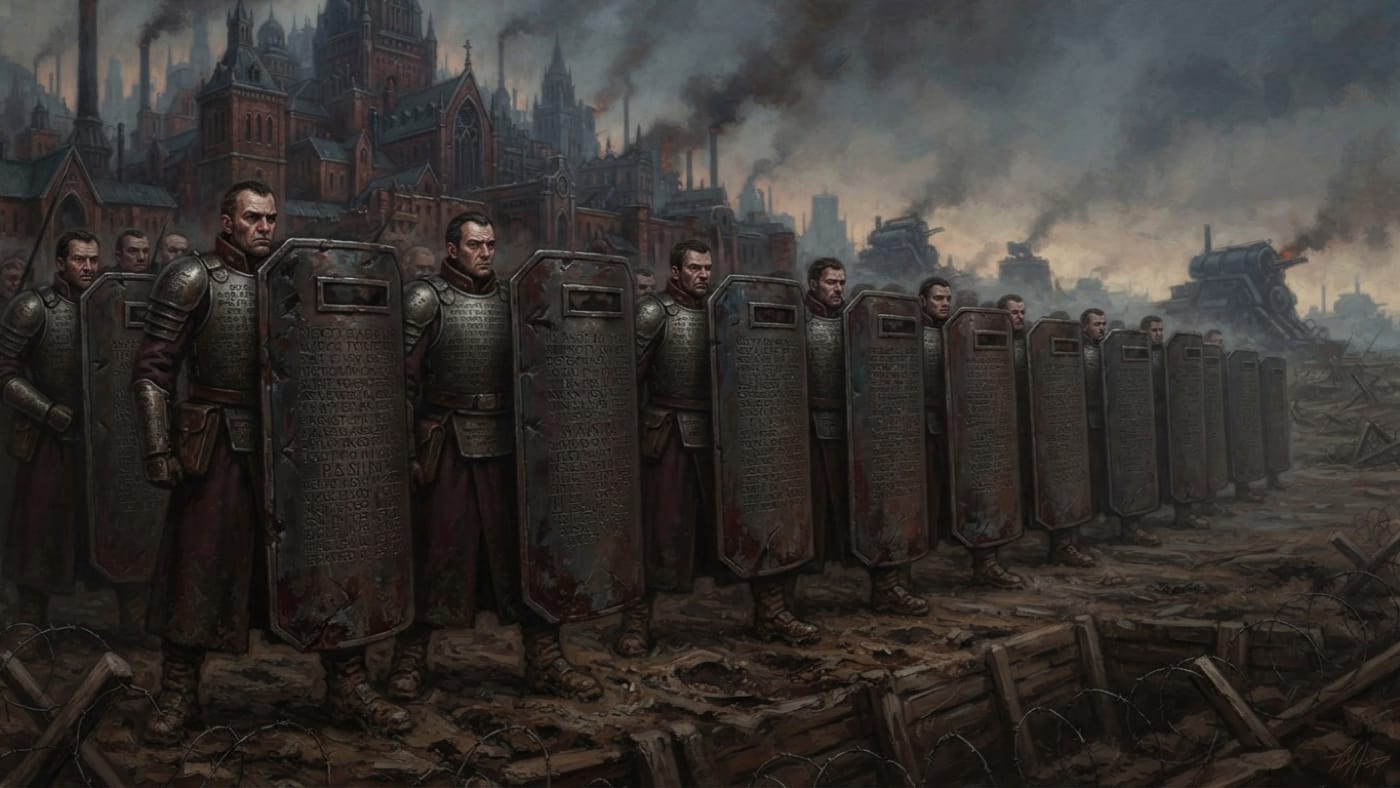
Two things entered in the defining record set the Guard apart from the common foot of any age. Their plate bears scripture. Their tower shields bear psalms. Everything else about them is the ordinary grammar of infantry, and this survey declines to gild it.
#On the Inscribed Plate
The Guard go into the line in plate, and the plate is written upon.
Here the Church's oldest military instinct appears in its least decorated form. Wherever a body is likeliest to be opened, the Church sets a word over it. A blow turned aside by steel may then be entered as a blow turned aside by scripture, and the breastplate becomes a page that happens to stop iron. The arrangement satisfies the clerk in me. A man is soft, brief and liable to panic. Plate is hard, durable and indifferent. Scripture is eternal. Lay the three one upon another, flesh innermost and the Word outermost, and you have a soldier filed in ascending order of authority, with his own body at the bottom of the hierarchy, where bodies belong.
Mark which way the inscription faces. It faces outward. The enemy reads it first, if the enemy reads. The wearer cannot see most of it and has no need to. He is the binding of a book he will never open, and nobody asks a binding about the contents.
This is the habit of the whole age, and the Guard merely wear it where it is easiest to see. The Sacred Ledger sets authority on paper and the seal sets it in wax. The Guard's plate sets it in steel across the ribs of a frightened man. Doctrine on a lectern weighs nothing. Fastened to a chest, it acquires mass, and the chest acquires a reason to remain where it has been placed.
The present definition records scripture upon the plate and names no verse. A surveyor who supplies verses the record does not hold is writing apocrypha in a Bureau hand. I have signed too many anathemas against that particular vice to commit it now, in my own entry, under my own seal.
The Guardsman himself wants to know one thing about his armour: whether it stops a bayonet. It is plate. It does what plate does. The rest is my department.
#On the Tower Shields and Their Psalms
The tower shield is the Guard's distinguishing possession, and any survey of them properly centres on it. It is tall and it is heavy, and it is carried by men classified Basic, which tells you what the Church thinks a basic man is for.
Its first duty needs no catechism. It stands between a body and whatever is thrown at that body. Set such shields along a rank and the enemy faces a front of metal where a moment before there was a front of men. Any sergeant in any army would recognise the principle, and most would approve it without asking to see the theology.
The second duty is the one that earns the Guard an entry in this Codex. Psalms are etched into the shield's face, and the defining record says of them that they turn back even sorcery itself. Read the clause again and attend to its grammar. The psalms are said to turn back sorcery. Whoever set that word in the roll knew his office. Said commits the Church to the teaching without committing a single clerk to a demonstration, and it reads equally well at a muster and at a graveside.
The teaching is sound, and I set my seal to it without hesitation. The Church holds that every prayer raised upon the field is a shield, and the Guard's shield is a prayer raised upon the field. The doctrine closes on itself like a well-folded letter, sealed where the two halves meet. The hosts of the Great Deceiver bring sorceries that curdle rivers and flay flesh from bone. Against them the Church sets psalms to the Creator, cut into metal before a man's body, and asks the man to stand behind them.
The survey does not say how etched words meet sorcery. It describes equipment and is no treatise on mechanism. I will not trouble Doctrine for a mechanism it has never needed. Admire instead the economy of the construction. Where the shield holds, the psalm is vindicated. Should a shield ever fail, the explanation will be ready before the smoke has cleared. It will concern the man behind the shield, his confession, his posture and the quality of his faith, and never once the psalm. The steel may be replaced. The verse is beyond audit.
The man behind the shield cares for none of this. He cares that it is tall.
#On the Present Definition
The commissioned survey closes on its findings, which are four and sufficient. The Bastion Guard are basic. They are line infantry. Their plate bears scripture. Their tower shields bear psalms said to turn back even sorcery itself.
The survey does not determine when the first Guardsman shouldered the first etched shield. It was commissioned to describe what stands in the line now, and it has done so. The Guard stand among the Church's armies, over which the Bureau of War holds its general charge. The survey assigns them to no particular stretch of the Sagittal Line, and neither shall I.
Certain readers will confuse the Guard with their neighbours in the rolls. The Bulwark-Catechists are elite: hulking zealots bound into exoskeletal armour and dragging reliquary shields, with a separate entry and a separate expense. The Shield Paladins keep their own record, their own drills and their own article, and nothing in theirs is to be carried into this one. The Bastion Guard are the ordinary article: a man, his written plate, his psalmed shield, and the ground he has been told to keep. Readers who still confuse the three are directed to the respective entries and to a period of supervised reflection.
Basic, then. Basic as bread, basic as ink, basic as the first line of a creed, which everyone recites and nobody thinks to praise. The elites receive the hymns. The Guard carry the psalms into the mud on their own forearms and are expected to hold them there.