
I've read the continuity reference, the style guides, the Saint-Bone Melter lore and the timeline. The generation hold was lifted on 29 September, and all the cross-link slugs below appear in the timeline inventory. Now writing the article.
#On the Eve
Aurel Eve is kept in several kiln yards on the eve of the first winter convoy. That is its entire calendar. No Church month claims it and no universal feast-table admits it. The yards that keep it do so because the wagons are coming, the season's first mortar is about to be made, and someone must say aloud what that mortar is for before the pit begins to hiss.
It belongs to the Saint-Bone Melters and to their disputed patron, Saint Aurel of the White Wall. Its standing is exact and modest: occupational devotion, tolerated, non-binding. A Melter who keeps it earns nothing by it. A yard that ignores it commits no offence. The rite forbids a public procession, so the city is not invited, and the city, which has never once asked to watch bone become lime, does not complain.
I have read every sheet the yards have been willing to show me. They record what is done and in what order. No sheet records who first did it, where, or in which year. The observance has an order of service and no birth certificate. In the trade this is unremarkable. Half the kiln prayers in use came into the yards the same way, carried in by apprentices who learned them from men with bad lungs.
#On the White Line and the Clean Bone
The rite is plain enough for a tired man to perform correctly. Its plainness is the reason Doctrine trusts it.
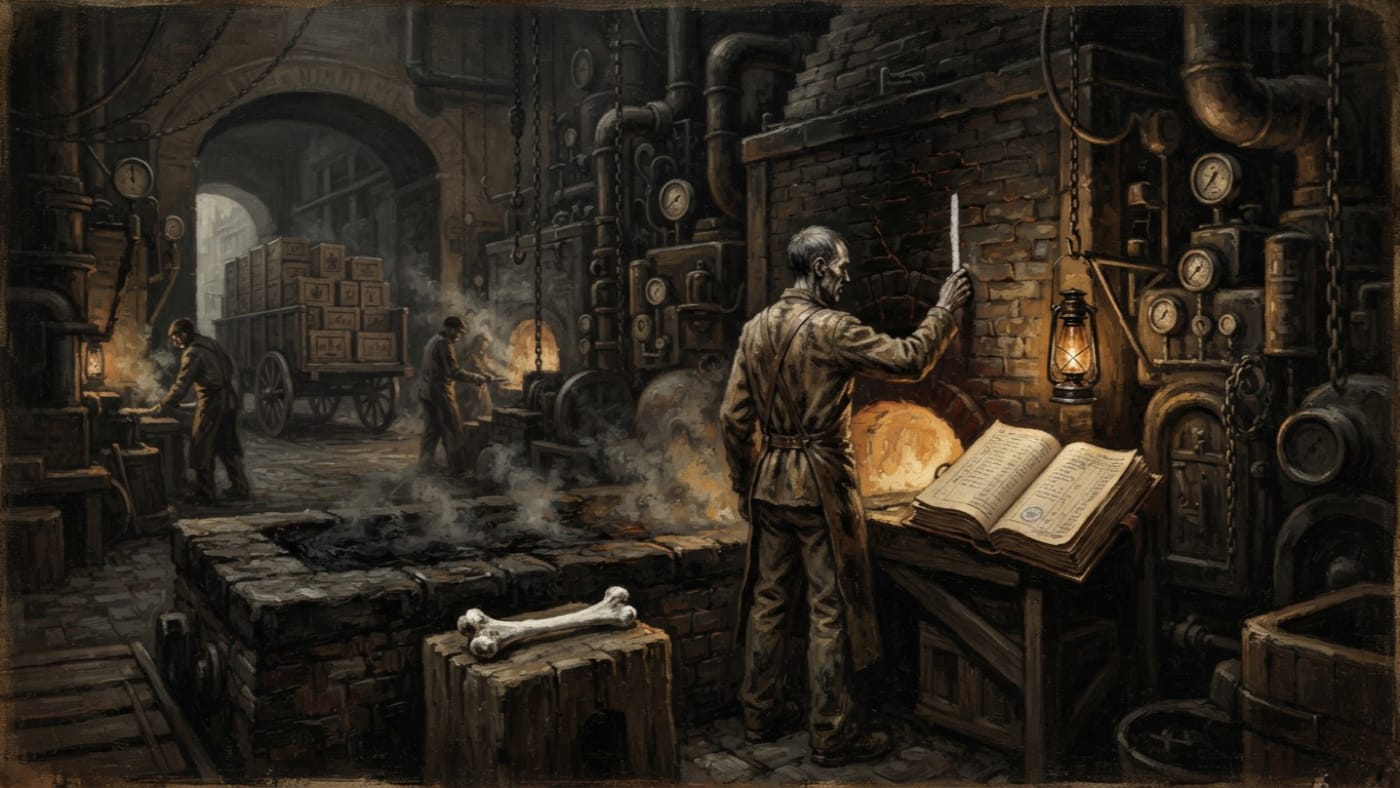
A white line is chalked on the kiln wall. A clean femur, usually animal, is laid before the slaking pit. The Master Melter says, "What shelters remains." The apprentices answer, "What remains is numbered." Then the day's first batch begins.
That is all of it. The chalk is ordinary chalk, the same grit the Melters rub on their eyelids at the end of a shift and use to mark crates. The wall is the kiln's own wall, black with soot and fissured by heat, so for the length of one sentence it carries the only clean mark in the yard. Any Melter who has seen the icon knows what the line repeats: the White Wall itself, drawn at the width of a thumb.
The bone matters more. It stands for the femur Aurel offers in every licensed image. It is usually taken from a beast, and the observance does not pretend otherwise. It is clean, and it is placed before the pit. The record says nothing more. It does not say the bone is burned, slaked, ground into the batch or kept afterwards as a relic of the day, and I decline to invent a fate for a sheep.
The batch ledger is also required. The observance names it among the necessary elements and says nothing more about it: not where it lies, which page is open or what the Master Melter writes in it before the first feed. What matters is that it is present. It is the same book in which every crate, weight and seal of the working year will be entered, and the rite puts it within reach of the words "numbered."
#On What Shelters
Aurel's legend puts him in the desperate decades after the Sundering. A besieged tower needed sanctified mortar, and Aurel offered his own femur to the masons. "Make me wall," he is reported to have said. No independent attestation of the man exists before A.S. 91. His first secure image is a Strasbourg broadsheet, cheaply cut and printed some time after the Concordat. The sentence is magnificent and its provenance is poor. Both facts are on file.
The Saint-Bone Melting Acts of A.S. 96 gave the legend its employment. The Bureau of Tithes declared sanctity deployable capital. Surplus, damaged, disputed and unassignable fragments were authorised for licensed reduction into lime and mortar. Reports from the Cracked Ring Sieges had already reached the policy offices: common mortar had cracked, and bone-lime had held. Tithes then offered its famous arithmetic. A femur in a reliquary inspires one chapel, while the same femur rendered to lime might hold a thousand feet of the Sagittal Line. This is rhetoric. No engineer has ever signed that figure, and I have looked.
In A.S. 104 the Bureau of Relics issued a provisional cult note recommending that Aurel be tolerated under the supervision of the Bureau of Doctrine. Nothing in that note, or in any file I have seen, dates the first Aurel Eve.
"What shelters remains" is the Church's doctrine of continuity cut down to three words. Holiness rendered into a wall has been moved, in the same way that a tithe is moved, and the Church does not count it as lost. Aurel consented, so the fragment consents, so the Melter is excused. I will say plainly what the Bureau says delicately. A saint whose single recorded act is to volunteer the exact material a new statute requires is useful to the offices that administer that statute, and they have used him thoroughly. Whether anyone made him to order is a question the dispute file has held open for a century. I have my opinion, and it is not fit for the file.
A.S. 112 instructional copies described Aurel as "canonised by universal acclaim."
Corrected: Aurel's patronage is provisional and his existence is disputed. His feast is kept locally in several kiln yards and appears on no universal calendar.
#On the Additions Forbidden
The prohibitions say more than the rite does. Each one closes off a way the eve might have grown into something the Church would then have to govern.
No blood oath. The eve binds nobody to anything. Its words are an exchange, and no vow is taken. A Melter who cut his palm over the pit would be turning a tolerated custom into an oath of fellowship, and the Church does not license brotherhoods sworn in lime.
No saint-fragment substitution. The femur must stay a clean and ordinary bone. Nobody may lay a real relic before the pit, however cracked, duplicated or conveniently unassigned it is. The sign must stay a sign. A yard that set a genuine fragment in the beast's place would be turning one devotion into an unrecorded rendering, and a Melter would need no instruction to guess what that invites.
No complaint songs. The yards have them, as every trade under heat and dust has them. They are not sung on this night, which is the one night the profession names its patron aloud.
No public procession. The eve stays in the yard. A procession draws a crowd, and a crowd means shrine agents and pilgrims counting which bones leave on which wagon.
Take note of what the eve does not permit. Keeping it grants no licence to render anything. Intake and classification go on as they did the morning before. Renderable material is sorted from protected material. The quiet hour is kept, and the chant wheel turns through its stages. The first batch after the response is subject to every safeguard that governs the hundredth. Aurel supplies the permission of conscience, and the regulations supply every other permission.
#On the Conscience of the Yard
The two factions share the patron and fight over his meaning. The Purity Melters, strengthened by the Purity Kiln Decree of A.S. 142, hold up Aurel's offered femur as proof that a bone must be clean, fully documented and willingly given before it is rendered. The Siege Melters hold up the same femur to argue that when a wall is cracking, the gift has already been made and the paperwork can follow it to the breach. No separate factional form of the eve is recorded. Both factions chalk the same line, and both believe it proves them right.
The shrine-keepers hate the whole cult. To them Aurel's consent turns every lost reliquary into an administrative outcome. If the saint gave freely, then any chapel that clings to its splinter is merely selfish. From their side of the argument, "what shelters remains" is a receipt written in the voice of a prayer.
Between these parties stand the men who do the work, with burned forearms, chalk in their lashes, coughs that follow them into sleep, and a winter of crates to process. The Ossuary Overflow Winters taught the trade that the dead arrive faster than they can be mourned. The eve does not answer that. It gives the answer a shape and a time of year.
Consider the word numbered. Nobody has identified the author of the response, and I will not invent one. Still, the word points at the only object in the rite that is neither bone nor chalk. The ledger is there. Whatever reaches the pit this winter will be weighed, entered and sealed under a batch mark. The apprentices do not promise that the dead will be remembered by name. They promise that the dead will be counted, and this is the only promise the ledger can keep.
Doctrine tolerates the rite because it disciplines the profession's guilt. Guilt with no liturgy becomes mutiny, and guilt given a liturgy becomes attendance. In my view the eve is the cheapest guilt-management instrument the Church maintains. It costs the Church one chalk mark and one animal bone a year, and the Melters bring both.
#On Present Observance
As of A.S. 201, Aurel Eve is kept in several kiln yards on the eve of the first winter convoy, with the same order, the same exchange of words and the same limits. Aurel's image hangs in yards at Bastion-Przemyśl, Bastion-Irongate and Bastion-Sibiu, and in the southern mortar annexes that supply Constantinople. A painting over a slaking pit does not prove the yard keeps the eve, and I list none of these yards as a confirmed observer. Some yards keep it and some do not. The survey records that and goes no further.
The Bureau of Rites has taken no action to raise the eve to a universal feast. The Bureau of Relics still classes Aurel as provisional. The kilns are lit on schedule either way.