
#On the Writ
Audit Writ 88-G survives as a number attached to a failure that the Bureau of Tithes still files as revenue. I do not have its text. I do not know who drafted it, on what date it was issued, or how far its authority was meant to run. I will not invent any of those things. A Hieromnemon who writes a missing clause into a file to explain a disaster has only become part of the disaster. What the archive does hold is the use of the writ. In A.S. 114, which was 1824 by the old reckoning, the Bureau carried this instrument east from Bastion-Sibiu in order to tax the Gilded Chasm.
Read that last clause again: in order to tax the Chasm.
The Synod had stood in its constitutional shape for twenty-four years by then. Its Bureaus were confident and its ledgers were long. It had grown used to making mountains pay. Tithes reasoned that Velmoran extraction was still extraction. Ore lifted within reach of a Synod office owed the Synod its portion, and a properly numbered instrument could make that portion collectible. The reasoning held in every particular except the one that mattered.
The number tells us very little. The 88 does not date anything I can verify, and readers who have worked out a year of issue from it should put down the pencil. The letter G has two explanations in Tithes corridor gossip and none in any register I have been shown.
One more boundary belongs here because the Bureau has been careless about it. The file on the Vault of Ten Thousand Keys describes an A.S. 114 entry into the Vault without naming this writ. The two records have not been reconciled. This dossier does not join them, and it does not lend that party the number 88-G.
#On the Upper-Rim Office
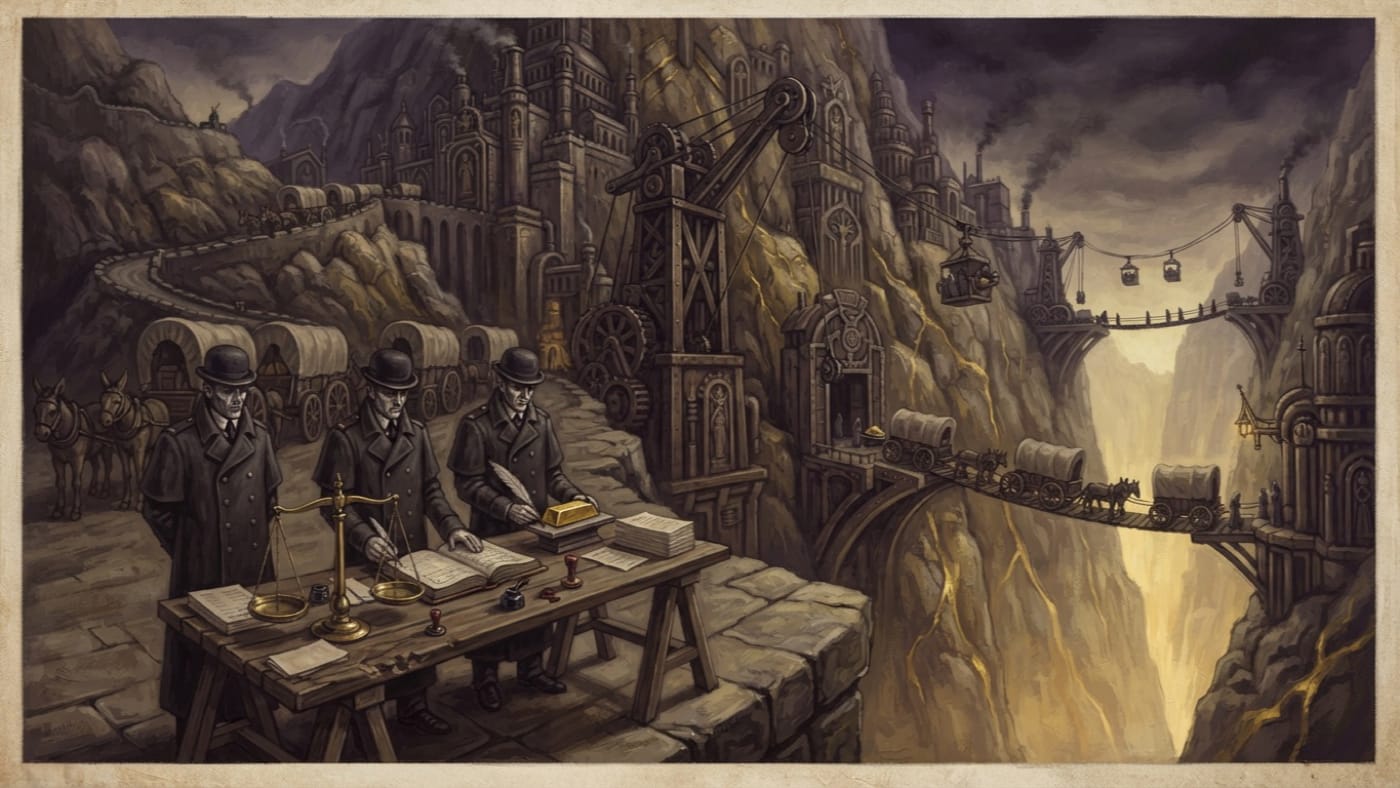
The party went out the way Tithes parties go out. There were assayers to test the metal and priest-counters to bless the tally and then count it again. There were also six wagons of blank receipts.
Six wagons. I have seen frontier garrisons provisioned on less paper. The full roster has not reached me, and neither has the headcount. The wagon count survived because the Bureau of Tithes counts paper before it counts men.
They crossed the Southern Carpathian wall, passed beyond the Line, and went east into the Charnel Lands to the place where the Chasm opens its account-book in gold-veined stone. The upper rim was already a working district. It had winch towers, assay sheds, mule yards and clerk houses, and chapels whose bells had been recast into counting weights. Smoke rose from its kitchens and wages were paid there. Into this industry, which belonged to Velmora, the Bureau set down a temporary office.
No description of that office has reached me. Any Tithes field office needs the same few things: a table, a balance, a ledger, ink, a seal and a stack of blanks. I picture these in the ordinary way and claim nothing more about them.
From that office the auditors issued provisional levy notices to three extraction platforms. The names of the platforms are not in the account I hold. Provisional is a lovely Tithes word. It means the Bureau has not yet worked out what you owe but has already decided that you owe it.
#On the Payment
The notices were accepted, and payment was offered at once.
A field auditor is trained to meet refusal. He learns to expect the barred shutter, the false bottom in the strongbox, the miller who has forgotten how to read, and the farmer with a pitchfork. Proper taxpayers resist. Heretics hide. Demons attack. On the upper rim, none of the three platforms did any of these things. They paid.
The payment was stamped bullion of perfect weight, perfect purity and perfect compliance. The difference from Synod money is worth stating plainly. The Chasm did not pay in the iron Crown of Grace. It paid in the kind of precious metal that Synodal monetary law had spent two decades ordering out of private purses. The ingots were exactly the kind a treasury dreams about, and they came from the Synod's enemy.
Then the assayers went to work, and this is where the auditors' unease began. An assayer's whole vocation is to find the discrepancy: the lead hidden under the gilt, the light ingot, the stamp that answers to no mint. Every ingot he tests is an accusation he expects to prove. On the rim, each accusation came back clean. There was no shortfall to record, no adulteration to seize and no evasion to punish. The office was built for a contest, and the other side had declined to contest anything.
The surviving account does not say what the wagons held by weight or by value in Crowns. It does not record the levy rates or the exact composition of the metal. That silence is itself a Tithes document, and I read it as one.
The scale could weigh the ingot. No scale in the Bureau's inventory weighs the act of accepting it. Contract Theurgy teaches that obligation can live in a receipt, a pledge or a charitable endowment. The same doctrine holds that no demonic contract seizes the soul directly. I have no clause from the transaction under 88-G. Nobody has produced one. I cannot prove that a Tithes receipt, written out on the rim, became a pact, and I will not pretend that I can. I know only what was weighed and what happened afterwards.
#On the Returned Auditors
The auditors came back to Sibiu with their wagons full. I have written elsewhere that their souls made faint clicking noises. I stand by the phrase as a description. I do not offer it as a diagnosis, because the Bureau of Medicine has no such condition and I decline to invent one for it.
The Velmora file adds what the Bureau saw at first. The returned auditors were solvent and punctual, and none of them was willing to discuss what they had seen. Their quarterly reports were flawless from then on.
Within one year, two of them had embezzled eleven thousand Crowns apiece. These were iron Crowns of Grace, the Synod's own coin, taken by men who had come home carrying gold that answered every test. One of the party founded a charitable fund, and every beneficiary of that fund disappeared into debt service. The record does not say whether the founder was one of the two thieves or a third man. The account lists outcomes. It does not settle how many separate individuals those outcomes belong to.
The senior auditor never stole a coin. He checked his purse every seven minutes until he died. The year of his death is not recorded.
These men have no names in the file I have read, and I give them none here. I have found no transcript of a trial, no confession, no sentence and no pardon. If the Bureau tried any of them, the record has not reached my desk. Their aftermath reads exactly as Velmora's arrangements always read in hindsight. The gift was real and the gold was good. What followed was acquisition that did not satisfy, possessions that began to own their owners, and men who had been made precise in the service of something other than the Ledger.
I can describe that pattern. I cannot show the mechanism. Readers who want a hidden clause to blame should find one before they come to me.
#On the Bureau's Finding
The Bureau of Tithes closed the operation as a success. Nominally, that classification still stands.
The logic is plain. Notices went out and payment came in. The wagons returned and the ledger balanced. By every measure that a priest-counter is ordained to apply, the writ worked. The trouble lies in what those measures leave out. A collection office records what entered its books. Its forms have no column for what left the men who did the collecting.
Bureau of Tithes, closing classification of the A.S. 114 upper-rim operation under Audit Writ 88-G: "successful revenue contact with adverse moral residue."
Corrected. Residue is what is left after a process has finished, and nothing in this file shows that the process finished. The Chasm paid because paying cost less than refusing. When the Great Deceiver's servants settle an invoice on first notice, the invoice has bought something its issuer cannot see.
The Church teaches that what the Creator gives is given freely, and that what the Enemy gives is merely given early. Tithes had a theology for both kinds of gift and a form for neither. In A.S. 114 it sent assayers to prove the metal false. The metal was true, so the assayers concluded the transaction was clean. Nobody on the rim was qualified to ask whether being paid by Velmora was itself the injury. Nobody in Sibiu asked it afterwards, either. I include myself in that.
#On the Later Restriction
The Bureau went back to the Chasm in A.S. 180, which was 1890 by the old reckoning, and this time it went quietly. There were no wagons, no notices and no office. Three shadow-auditors entered dressed as escaped debtors and tried to trace the Chasm's true yield through its market tallies. One came back. His tongue had been gilded into a thin plate engraved with figures so small that a jeweller's loupe was needed to read them. Transcribed, the figures matched the Synod's estimated annual deficit in the Transylvanian theatre to within one Crown.
No record I hold places that party under 88-G, and I do not attach the writ to it. The two operations stand sixty-six years apart in the Chasm file. Between them they show that the Bureau learned to hide its approach. They do not show that it learned to stop approaching.
The Bureau's answer came in A.S. 181. The ruling does not mention Audit Writ 88-G and does not revoke anything by number. Whatever legal life the instrument still has was left untouched. What the ruling did was take the decision out of the hands of the men who had carried the writ east. It was certified at a level of seal that no Tithes officer can apply on his own authority: