
#On the Strip Below the Wall
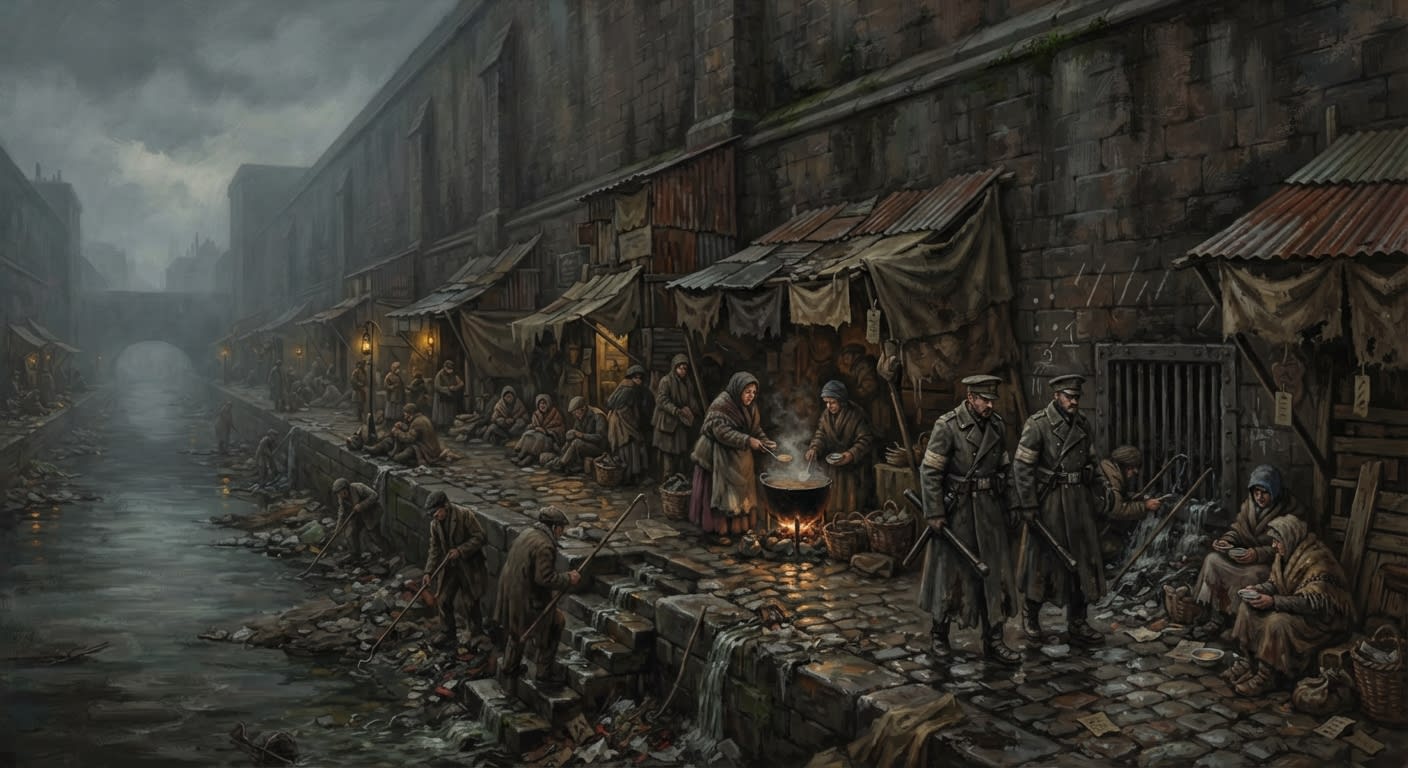
Ash Canal Walk is the strip of ground outside the south wall of the Cloister of Miscounted Beads. It runs beside the Ash Canal for as far as a sober man can bear the smell. Where the tar sheds allow, it is eight paces wide. Where they do not, it is two. Nobody laid its cobbles and everybody has broken them. The awnings are patched with fever cloth, chapel sacking and the canvas of confiscated pilgrim tents.
No office founded the Walk. It grew the way a scab grows along a cut, and the cut here is the drainage ditch dug after the A.S. 94 western-gate surge. Men expelled at the gate slept by the water because it was the only thing near the Cloister that did not ask their names. Vendors followed the sleepers. Brokers followed the vendors. The Outer Watch followed the brokers at a distance measured by bribe. By the time Records noticed the lane, the lane had customs.
Municipal maps show it as a sanitation margin. The Cloister Chapter lists it as extramural. The Watch calls it the wet side. The sleepers call it the Walk, which is generous, since nobody on it is going anywhere.
Respectable people stand on the Walk only with a warrant, a corpse, or a lie polished enough for daylight. I came with all three, and still the broth woman nearest the Yard hatch looked at me as if I owed her for the cup.
#On Rain, Blood, and Things That Float
The Lost Procession Yard drains south. Channels cut into its clay carry rain and blood to the Yard hatch. The hatch gives them to the Canal. When rain lifts the water over the lower steps, the Canal hands part of the cargo back to the Walk. Whatever the Yard has sorted, the Walk gets back unsorted.
Most of it is wrist tags: sodden card stubs still knotted into twine loops. White turns up most often. Yellow is worth the most. A yellow tag fished from the Canal can be dried under a tar-shed lamp, pressed flat and tied onto a stranger's wrist before the Intake clerks change their twine. Nobody picks up the black ones. To be suspected of carrying a counterfeit string, even secondhand, is worse than going hungry.
After the tags come straw, lice combs, fever cloth, candle ends, petitions too wet to read and too dear to throw away, the odd bead, and the folded prayers pilgrims give to drains because the saints will not see them there. Children with hooked sticks work the lower steps after rain. The Watch calls them pickers. Nobody calls them anything kinder.
#On the Watch Patrols
Outer Watch pairs walk the perimeter clockwise at first bell, third bell, dusk and after snuff. Every watchman hopes his partner draws the south leg. Wet stones make the boots heavy. Refuse hides knives. Within three weeks of a posting the ash armband takes on the Canal's colour, and nobody inside the wall will sit beside it at supper.
The patrol checks the hatch seal, the grille and the wall chalk. It counts the sleepers and does nothing about them. The Watch keeps the hatch key at the Post, where it smells of vinegar. The patrol carries only the right to look at the nail. Payment comes in the Post's usual currencies: dry socks, candle ends, sealed broth. The broth women pay in broth, which makes them the best-protected merchants in the lane. One of them has kept the same pitch by the Dorm grating for eleven years, and her soup is famous for its bones. She says the bones are mutton, and the Watch agrees.
The last line comes from the Chapter. Scrubbed chalk only reappears on a brick nobody is watching, and Prior-Scribe Vale likes his criminals legible.
#On Markets After Rain
The Grave-Name Market proper keeps to the rubble lots beyond the eastern drain wall, near the refuse canal and the tavern called the Ninth Count. After rain it spreads. Dead names come up in wet weeks, so the Market goes where the water goes, and the water goes along the Walk.
It trades under the awnings and in the lee of the tar sheds. The stock is small. Half-cleared tags. Scraps of sponsor wax that runners for the Sponsor-Seal Brokers swear came from a real seal. Corpse notices copied onto the backs of ration slips. News is sold by the sentence: a grandfather's name was seen on a slate, a wife's bead washed out of the hatch on the fourth night, a sponsor mark can still be recovered by Thursday for a fee.
Families stand along the south wall to buy it. They come from Strasbourg, the waystation spur and the Clearance Gate, some of them turned out only yesterday and waiting for somebody still inside. Most of what they buy is false. The true news costs more and keeps them awake longer.
Broker boys run the Walk. They cough prices. They chalk the low bricks with two dots for a berth, a slash for sponsor interest and a hooked line for a name warm enough to sell. They sleep in turns under the Yard hatch, where the runoff keeps the stones from freezing.
An A.S. 199 municipal works report describes Ash Canal Walk as "a non-commercial sanitation margin, used for access to drainage works only."
Corrected for Doctrine circulation. The Walk is used for access to drainage works, broth, berths, sponsor scraps, dead names, fever cloth, Watch favours, and grief. The drainage works are the least-visited attraction.
#On Listeners and Hatch Work
The Quiet Thread comes to the Walk because the water goes under brick there, and the Thread holds that what runs below the wall keeps a count the Cloister cannot correct. Its adherents kneel at the grilles with their knees in the runoff. They lower beads on black thread, count under their breath and pull the beads back up. Others sit silent on the wet stones for hours. The Watch steps around them, since a silent man cannot be arrested for noise. They draw knots in ash paste on the lowest courses of the wall, where the next rain will half erase them. The Walk's sleepers are careful not to lie on the marks.
The hatch-tamperers have plainer aims. Reed tubes pass inward through the bowed south grille carrying sponsor notes, salt and warnings. Wax balls pass outward carrying beads. At the Dorm Rows grating, a detainee inside and a relative outside can talk through the drain while the water runs. The Chapter maintains that nobody talks this way. The Walk maintains a rota.
Cloister Chapter memorandum, A.S. 200: "No correspondence of any kind passes the south wall."
Amended. No correspondence of any kind passes the south wall through any aperture the Chapter has agreed to count. The drains have not been counted since the grates went unrepaired in A.S. 193.
Sometimes a voice answers at the grating when no detainee is on the other side. The Walk has a rule for this, older and stricter than the Watch's: whoever you are waiting for, you do not give your own name to the water. The broth women enforce it with ladles.
SOUTH LEG REPORT — ASH CANAL WALK, A.S. 201, RAIN QUARTER Patrol pair logged a woman at Dorm grating asking for her son by name. Voice from drain answered with son's name, route colour, and berth number. Son recorded as expelled at Clearance two days prior; whereabouts ██████. Woman paid the nearest broker for confirmation. Broker refused payment and left the Walk. Disposition: grating chalked; woman removed cityward; ██████████████.
#On Fever and Mercy
Canal fever lives on the Walk. It breeds in the damp under the awnings, spreads through the shared broth cups and settles in children who play near the lower grilles. The vinegar carts come twice a day under the sanitation warrant of the Bureau of Mercy. They douse the steps, the sleepers and whichever broker is too slow to move, and they leave. In the tar sheds the fever sleepers lie under rags with their faces to the wall. It is the only direction on the Walk with no one selling anything.
The sleepers come from three places. Some are expelled at the Clearance Gate. Some are driven off the market awnings by the city constables. The rest are pilgrims turned away at Intake because they looked too blessed. Jossa Rill fears above all else that fever will be blamed on her Yard. Nobody has ordered it, but the fever cases diverted from her Porch end up on the Walk, where fever can be blamed on the city. The city magistrates inquire about vagrancy at the south wall. The Chapter answers that the Walk is municipal. The magistrates answer that its drainage is Cloister runoff. Both answers are filed. The sleepers stay where they are.
#On the Present Walk
In A.S. 201 the Walk carries more than in any previous year. Redirected traffic through the western gates since A.S. 198 has pushed the Cloister past its design, and the Yard recorded fourteen thousand two hundred arrivals in A.S. 200. Too many of them end up on the Walk: expelled, diverted, unsponsored, or simply waiting. There is more broker chalk than wall to hold it. The tar stores are low. The south grille is bowed. The grates promised in A.S. 193 are still promised.
Five Anomoly Weeks are projected for the year. In each one the Ash Canal hatch is nailed and blessed, chains are doubled at the south gate, no name passes through a wall aperture, and no watchman answers a voice from the water. The Walk does not empty. Prices rise. The Quiet Thread kneels closer to the grilles. The broth women serve their soup cold, because a fire would show the Watch where they are.
I walked the lane at dusk after the last sealed week. The water was high and black, and the tar sheds wept. A picker boy showed me a yellow tag he had fished from the lower step, dried and pressed. The handwriting was Rill's. The name on it had not yet come through the gate.
I paid him for it. The Watch pair behind me looked at the wall.