
#On the Unpublished List
Appendix C is a schedule, and schedules are the humblest instruments in Synod law. Its title is "Facial Indicators of Unsanctioned Contemplation." It hangs from the Twelfth Amendment of A.S. 196 as a seal hangs from a writ: small, heavy, and the only part anyone fears. It founds nothing of its own. The Catechism of Obedience had already declared the interior life licensed ground. Appendix C only tells the examiner where on the citizen to look for the trespass.
The parishes call it the Face List. The Codex records that vulgarism with distaste. No parishioner has read the thing. Its full text remains unpublished by order of the ██████████████, with the concurrence of the Bureau of Doctrine and the Bureau of Purity. The reason given is short enough to carve over a lintel: publication would allow subjects to suppress the indicators.
So the secrecy is part of the instrument. A published list is a lesson. An unpublished list is a climate.
#On the Face as Evidence
The public abstract names three things: prolonged stillness, unfocused gaze, and "a quality of expression suggesting the subject is thinking about something the Bureau has not approved." The first two are observations. The third is jurisdiction dressed as an observation, and it is the finest sentence the Synod has issued this century.
The doctrine underneath is old and plain. Article 4 licenses hope, consolation, prophetic utterance, and prayer beyond the prescribed forms. Before A.S. 196, enforcement followed that licence through speech, writing, gesture, and outward expression, then halted at the skin like a bailiff at a chapel step. The Twelfth Amendment carried the licence inward, to private hope, grief, devotional warmth, doubt, meditation, and contemplation. That left the Bureau with a practical embarrassment. A trespass committed inside a skull must still be witnessed somewhere. Appendix C chose the nearest surface.
The face lags behind instruction. It softens during a psalm it was told to endure. It goes still after a widow's licensed hour of lamentation has expired. It stares past the preacher at a patch of plaster where, the Bureau presumes, something unlicensed is standing.
APPENDIX C — RESTRICTED EXTRACT Indicator 7: ███████████████████ Indicator 11: asymmetry of hope response after ration prayer. Indicator 14: █████████████████████████████ Indicator 19: expression suggesting interior reply. Indicator 23: absence of expression where expression has been instructed. Remainder: withheld.
Consider Indicator 23 and be afraid of it. A face that shows too much is evidence. A face that shows nothing where something was instructed is also evidence. Between the two lies a strip of ground about as wide as a Catechism answer, and the citizen is required to live on it.
#On Referral and Examination
The White-Mantled Inquisitors were built for language. Chalklings mark the walls. Mantle Examiners hold confiscated broadsheets to the lamp. Chainmasters seal districts, and Glass-Canons go alone into rooms where phrases have misbehaved. Their business was the Index Claritatis, and their glass chains answer to words. The Twelfth Amendment gave the same officers referral authority over faces. The chain, which the Bureau trusts with forbidden phrases, has never been asked to grade an eyebrow. For that the Inquisitor has eyes and a form.
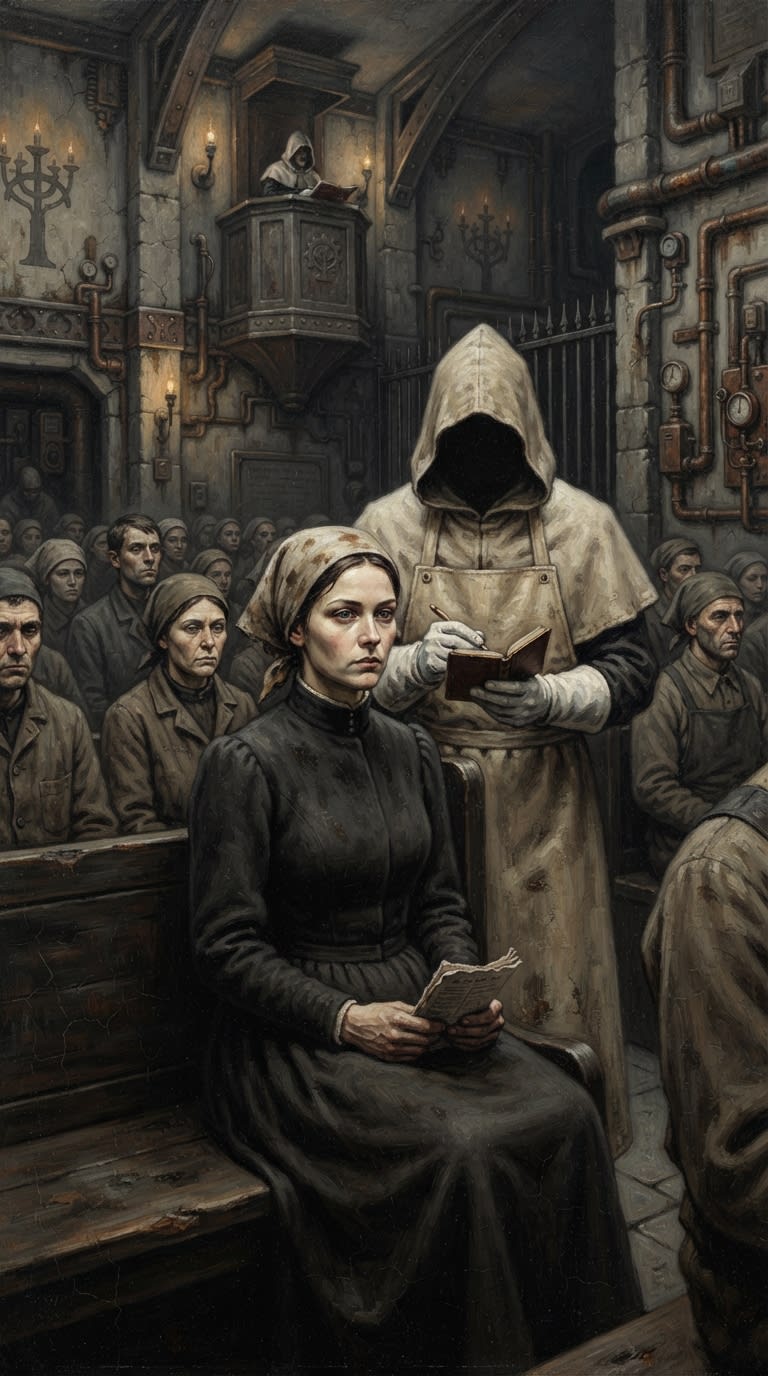
Observation takes place wherever faces gather in obedient rows: ration lines, tenement stairs, tram queues, factory chapels, Catechism School benches, burial queues, the back pews of the parish nave. The officer notes the indicator by number and the hour by the clock. Then comes the approach. The White-Mantled do not touch. They stand close enough that the subject's breathing becomes part of the record, and the white glove stays clean because it has no work to do.
The questions are few. What is the approved object of your present hope? When did you last grieve, and was the grief licensed? What were you thinking during the stillness? The answers carry less weight than the interval before them. A quick answer suggests rehearsal. A slow answer suggests an interior that had to be consulted. The correct interval is known to the examiner and to Doctrine, which is one more person than necessary.
A referral then travels two roads at once. The first is Article 9 compatibility review, where the drafting Exegete Hallam did in A.S. 92 still does its patient work. Article 9 leaves heresy undefined until Doctrine names it, and the naming reaches back to the first formation of the thought. So the file waits. If Doctrine later declares the contemplated matter heretical, the face noted in a ration line becomes the earliest surviving evidence of a crime that began before anyone knew it was one, the criminal included.
The second road is Article 19, added by Grand Inquisitor Severian at the Eighth Doctrinal Congress of A.S. 134. Suspected heresy or spiritual unease must be reported within twenty-four hours, and failure to report is participation. Before Appendix C, a neighbour had to hear something before the clock started. Now it is enough to have seen a face. Silence is shelter, the Article's gloss runs, and Appendix C has found a way to take an inventory of the shelter.
#On Counterfeit Lists
Whatever text the Synod withholds, the peasantry prints its own version. Counterfeit schedules pass from parish to parish on the breath of women at the well. In the schoolyards, children play a game in which one child calls out numbers and the rest must hold their faces until someone laughs. The one who laughs is "referred." Parents beat the game out of them, then catch themselves playing it alone at the washbasin.
One Antwerp pamphlet advised "blank devotional gratitude" as the safest expression, and it was seized. Perhaps Indicator 23 was drafted with such pamphlets in mind, and perhaps it came first. I decline to say which, and the reader may study my declining.
The rest is rumour, and the Codex files it as rumour. A Strasbourg seamstress is said to swear the list runs to hundreds of numbers. A Rhine bargeman is said to insist it runs to three pages, the rest left blank for the examiners to fill as needed. Neither has seen it. The true number of indicators is withheld along with everything else, and any figure you hear in a tavern is a counterfeit that happens to be free.
Instructional copies issued to parish examiners in A.S. 196 described Appendix C as "withheld pending completion."
Corrected. Appendix C is withheld because it is useful. Completeness has never been a condition of Synod law, as any reader of Article 9 will confirm.
#On Administrative Mercy
The Bureau of Mercy objected to the Twelfth Amendment on grounds of grief, privacy, and pastoral care, and it lost. It may take a thin comfort from how the schedule is presented, since Purity circulars describe the withholding as a kindness. A citizen who cannot study for the examination cannot fail it through poor preparation. No one is disadvantaged by ignorance when the ignorance is shared equally by all. It is the most egalitarian instrument the Synod owns.
The Bureau of Tithes has no formal part in Appendix C, and it has noticed. Licensed hope carries a levy. Unlicensed hope carries none, which Tithes considers the graver sin. In the Tithes ledger, every face referred under the schedule is a small evasion of the duty on consolation, a citizen caught drinking from a well the Bureau had not yet metered. I am told the actuaries are drafting. The actuaries are always drafting. It is how they pray.
#On Present Use
As of A.S. 201, the schedule is in active use across Synod territory, from Strasbourg to the forward settlements of the Sagittal Line. Catechism instructors drill approved facial readiness between the morning recitations, and a child who smiles at the wrong clause loses a mark and gains a file. Funeral audits measure stillness at the graveside against the licensed hour of lamentation. Ration prayer is observed from a raised desk by a clerk whose own face has been approved in advance. Factory chaplains post cards above the punch clocks, each bearing a single indicator number and nothing else, and leave the workers to decide what it means. Parish examiners sit in the last pew, where no face can turn to see them and they can see every face, and they write with very small pencils.
The forward settlements file more referrals per head than any parish in the interior. Purity blames the heresy that festers near the front. The garrisons blame the view. A soldier who has watched the dark beyond the Line for a full night comes back to the ration queue with an unfocused gaze, and the schedule has no clause for what that soldier was looking at. The file is opened all the same.
Compose yourself, reader. You have been reading for some time, and your expression has changed.